-
Use Cases
-
Resources
-
Pricing
The history of DNA research traces humanity's journey to understand heredity and the molecular basis of life. Beginning with Gregor Mendel's foundational genetics work in the 1860s, scientists gradually identified DNA as the carrier of genetic information. Key milestones include Watson and Crick's discovery of the double helix structure in 1953, the development of recombinant DNA technology in the 1970s, the completion of the Human Genome Project in 2003, and the revolutionary CRISPR-Cas9 gene-editing tools of the 21st century. More Less
1869
% complete
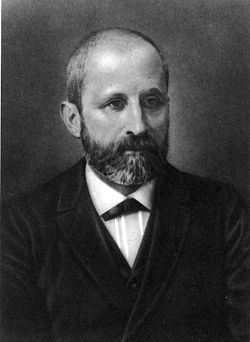
The Swiss physician Friedrich Miescher discovered a microscopic substance in the pus of discarded surgical bandages, becoming the first person to isolate what would later be known as DNA. He called the substance 'nuclein', laying the foundation for all future research into nucleic acids and heredity.
Image source: Friedrich Miescher
1878
% complete
In 1878, Albrecht Kossel isolated the non-protein component of 'nuclein', which he identified as nucleic acid. This work built directly on Miescher's earlier discovery and helped establish the chemical nature of the material found in cell nuclei.
Image source: Albrecht Kossel
1885
% complete
Following his isolation of nucleic acid, Albrecht Kossel went on to isolate its five primary nucleobases: adenine, cytosine, guanine, thymine, and uracil. This achievement revealed the fundamental building blocks of nucleic acids and earned him recognition as a pioneer of biochemistry.
Image source: Nucleotide base
1909
% complete
In 1909, Phoebus Levene identified the base, sugar, and phosphate nucleotide unit of RNA, which was then named 'yeast nucleic acid'. His work clarified that nucleic acids are composed of repeating nucleotide units, a crucial insight for understanding their structure.
Image source: Phoebus Levene
1925
% complete
The first recognized modified DNA base was 5-methylcytosine, which was found in the genome of Mycobacterium tuberculosis in 1925. This discovery opened the door to the study of DNA modifications and epigenetics.
Image source: 5-Methylcytosine
1928
% complete
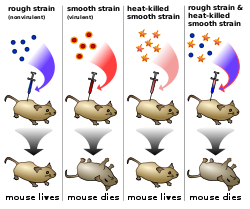
In 1928, Frederick Griffith discovered that traits of the 'smooth' form of Pneumococcus could be transferred to the 'rough' form of the same bacteria by mixing killed 'smooth' bacteria with the live 'rough' form. This 'transforming principle' suggested that some hereditary substance could pass between organisms.
Image source: Griffith's experiment
1929
% complete
In 1929, Phoebus Levene identified deoxyribose sugar in 'thymus nucleic acid' (DNA). This discovery distinguished DNA from RNA chemically and completed the basic picture of the DNA nucleotide unit.
Image source: Deoxyribose

1933
% complete
In 1933, while studying virgin sea urchin eggs, Jean Brachet suggested that DNA is found in the cell nucleus and that RNA is present exclusively in the cytoplasm. This work helped clarify the distinct cellular locations and roles of the two nucleic acids.
1943
% complete
In 1943, Oswald Avery, along with co-workers Colin MacLeod and Maclyn McCarty, identified DNA as the transforming principle identified in Griffith's experiment. Their work provided strong evidence that DNA, rather than protein, carried genetic information.
Image source: Avery–MacLeod–McCarty experiment
1927
% complete
In 1927, Nikolai Koltsov proposed that inherited traits would be inherited via a 'giant hereditary molecule' made up of 'two mirror strands that would replicate in a semi-conservative fashion using each strand as a template'. His remarkably prescient hypothesis anticipated the double-helical structure of DNA decades before it was confirmed.
Image source: Nikolai Koltsov
1937
% complete
In 1937, William Astbury produced the first X-ray diffraction patterns showing that DNA had a regular structure. These pioneering images provided the first physical evidence of DNA's ordered architecture and paved the way for later structural studies.
Image source: William Astbury
1951
% complete
By 1951, Alec Todd and collaborators at the University of Cambridge had determined by biochemical methods how the backbone of DNA is structured via the successive linking of carbon atoms 3 and 5 of the sugar to phosphates. This established the chemical connectivity of the DNA chain.
Image source: Alexander R. Todd
Oct 1, 1951 - Dec 31, 1951
% complete
Late in 1951, Francis Crick started working with James Watson at the Cavendish Laboratory within the University of Cambridge. Their partnership would lead to one of the most important scientific discoveries of the twentieth century.
Image source: Cavendish Laboratory
May 1952
% complete
In May 1952, Raymond Gosling, a graduate student working under the supervision of Rosalind Franklin, took an X-ray diffraction image labeled 'Photo 51' at high hydration levels of DNA. The image became critical evidence for the double-helical structure of DNA.
Image source: Photo 51
1953
% complete
In 1953, the in vivo B-DNA X-ray diffraction-scattering patterns of highly hydrated DNA fibers were analyzed in terms of squares of Bessel functions. This mathematical treatment provided rigorous support for the helical parameters of the B-form of DNA.
Image source: DNA
Feb 1953
% complete
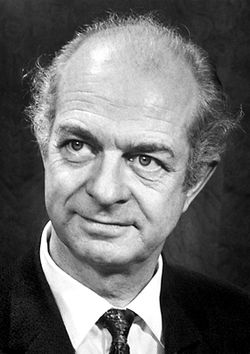
In February 1953, Linus Pauling and Robert Corey proposed a model for nucleic acids containing three intertwined chains, with the phosphates near the axis and the bases on the outside. The model ultimately proved incorrect, but it spurred Watson and Crick to accelerate their own work.
Image source: Linus Pauling
Feb 28, 1953
% complete
On 28 February 1953, Crick interrupted patrons' lunchtime at The Eagle pub in Cambridge, England to announce that he and Watson had 'discovered the secret of life'. They had worked out the double-helical structure of DNA, revealing how genetic information could be stored and copied.
Image source: Molecular Structure of Nucleic Acids: A Structure for Deoxyribose Nucleic Acid
Apr 25, 1953
% complete
The 25 April 1953 issue of the journal Nature published a series of five articles giving the Watson and Crick double-helix structure of DNA along with evidence supporting it. These modest one-page papers transformed biology forever.
Image source: Nature (journal)
1957
% complete
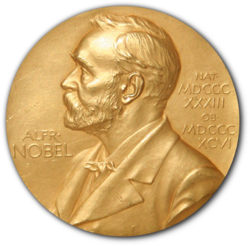
Alec Todd was awarded the 1957 Nobel Prize in Chemistry for his work on nucleotides and nucleotide coenzymes, including his determination of how the backbone of DNA is structured via successive linking of carbon atoms 3 and 5 of the sugar to phosphates.
Image source: Nobel Prize in Chemistry
1962
% complete
In 1962, after Rosalind Franklin's death, Watson, Crick, and Wilkins jointly received the Nobel Prize in Physiology or Medicine for their discoveries concerning the molecular structure of nucleic acids. Franklin, who died in 1958, could not share the award since Nobel Prizes are not awarded posthumously.
Apr 2023
% complete
In April 2023, scientists, based on new evidence, concluded that Rosalind Franklin was a contributor and 'equal player' in the discovery process of DNA, rather than otherwise as may have been presented subsequently after the time of the discovery. Her critical contributions to determining the double-helix structure received long-overdue recognition.
Image source: Rosalind Franklin
1952
% complete
DNA's role in heredity was confirmed in 1952 when Alfred Hershey and Martha Chase showed through experiments with bacteriophage T2 that DNA, not protein, is the genetic material. Using radioactive labeling, they demonstrated that only DNA entered bacterial cells during infection.
Image source: Hershey–Chase experiment
1957
% complete
In an influential presentation in 1957, Crick laid out the central dogma of molecular biology, foretelling the relationship between DNA, RNA, and proteins, and articulated the 'adaptor hypothesis'. This framework organized the flow of genetic information within biological systems.
Image source: Central dogma of molecular biology
1958
% complete
Final confirmation of the replication mechanism implied by the double-helical structure came in 1958 through the Meselson–Stahl experiment. Using density gradient centrifugation, Matthew Meselson and Franklin Stahl demonstrated that DNA replicates semi-conservatively.
Image source: Meselson–Stahl experiment
1994
% complete
Deoxyribozymes, also called DNAzymes or catalytic DNA, were first discovered in 1994. These single-stranded DNA molecules can catalyze chemical reactions, expanding the known functional repertoire of DNA beyond information storage.
Image source: Deoxyribozyme
2010
% complete
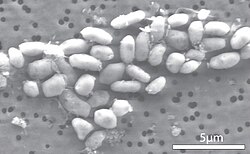
A 2010 report announced the possibility of arsenic incorporated into the DNA backbone of the bacterium GFAJ-1, though the research was disputed. Subsequent evidence suggests the bacterium actively prevents the incorporation of arsenic into the DNA backbone and other biomolecules.
Image source: GFAJ-1
1984
% complete
DNA profiling was developed in 1984 by British geneticist Sir Alec Jeffreys. His technique allowed individuals to be uniquely identified from their DNA, revolutionizing forensic science, paternity testing, and many other fields.
1986
% complete
In 1986, DNA analysis was first used in a criminal investigation when police in the UK requested Alec Jeffreys of the University of Leicester to prove or disprove the involvement of a suspect who claimed innocence in the matter. The suspect was exonerated, demonstrating the power of DNA evidence.
Image source: DNA profiling
1988
% complete
Further DNA profiling led to the positive identification of Colin Pitchfork, who in 1988 was found guilty of both rape-murders in the Enderby murders case. It was the first time DNA fingerprinting had been used to convict a killer.
Image source: Colin Pitchfork
Or browse the full history timeline directory, with more than 2,000 topics.
This History of DNA Research timeline was generated with the help of AI, using information found on the internet.
We work hard to keep these timelines accurate, but mistakes do get through. If you spot one, email us at [email protected] and we'll fix it for future visitors.
Generate yours with AI or build it from scratch, for free.
Export your timeline, add your own events, edit or remove AI-generated events, and much more
No credit card required.
Cancel anytime.
Cancel anytime.
You can create an unlimited number of timelines with up to 10 events on each one, customize how they look, export them to PDF, PNG, PowerPoint, CSV, and Excel, and share them with a link. Paid plans raise the event limit and add features like spreadsheet imports and collaborators.
Yes. You can cancel your subscription from your account page at any time, and you will not be charged again. Your subscription stays active for the rest of the period you already paid for.
Yes. We will email you a reminder before the annual renewal, and we will also email you a receipt.
Yes. You can email us within 15 days of any payment, and we will issue you a full refund.
Check out our pricing docs or send us an email anytime: [email protected].