
-
Use Cases
-
Resources
-
Pricing
Gambling has been a part of human civilization for thousands of years, evolving from simple games of chance played with dice and tiles in ancient societies to the massive global industries of casinos, lotteries, sports betting, and online gambling we know today. This timeline traces the key milestones in the development of gambling across cultures and centuries. More Less
3000 BCE
In Mesopotamia, the earliest known six-sided dice date to about 3000 BCE, marking one of the oldest archaeological traces of gambling. These early dice were used in games of chance, showing that wagering on random outcomes was already part of human culture over five millennia ago.
Image source: Dice

400 BCE
The ancient Indian text Arthashastra (c. 4th century BCE) recommended taxation and state control of gambling. This early treatise on economics and governance shows that gambling was widespread enough in antiquity that rulers sought to regulate and profit from it rather than simply ban it.
800 CE
Playing cards appeared in China during the 9th century CE, providing a new medium for games of chance and skill. Card games would eventually spread along trade routes to Persia, the Middle East, and Europe, becoming one of the most popular vehicles for gambling worldwide.
Image source: Playing card

900 CE
Lotto games and dominoes, precursors of the modern gambling game Pai Gow, appeared in China as early as the 10th century. These games of chance became deeply embedded in Chinese recreational culture and influenced later lottery-style gambling across Asia.
Image source: Pai gow

1300
Records trace gambling in Japan back at least as far as the 14th century. Games of chance flourished despite periodic official prohibitions, and gambling traditions in Japan evolved into distinctive forms such as betting on hanafuda card games and later public sports wagering.
Image source: Gambling in Japan

1600
The Persian game As-Nas, dating back to the 17th century, is strongly associated with gambling and is considered a key ancestor of modern poker. Played with a small deck of ornate cards, As-Nas involved betting rounds and hand rankings that shaped later card games.
Image source: Nas

1567 - 1569
Queen Elizabeth I chartered a lottery that was drawn in 1569, using it to raise funds for public works such as harbor repairs. The English lottery is an early example of a government-sanctioned gambling enterprise used for state financing.
Image source: Gambling Commission

1600
Gambling has been a main recreational activity in Great Britain for centuries. From aristocratic card salons to public lotteries and racetrack betting, wagering became woven into British social life, prompting successive waves of legislation to license and regulate it.
1638
The Ridotto opened in Venice, Italy in 1638, becoming the first known casino in history. Established by the Venetian government to provide controlled gambling during carnival season, it set the model for licensed casino houses that would later spread across Europe and the world.
Image source: Ridotto

1700
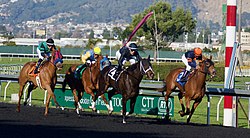
For over three centuries, horseracing has been a favorite theme for gambling. Organized racing with formalized betting emerged in Britain in the early 18th century, giving rise to bookmakers, racecourses, and wagering traditions that spread throughout the British Empire and beyond.
Image source: Horse racing
This History of Gambling timeline was generated with the help of AI, using information found on the internet.
We work hard to keep these timelines accurate, but mistakes do get through. If you spot one, email us at [email protected] and we'll fix it for future visitors.
Generate yours with AI or build it from scratch, for free.


