-
Use Cases
-
Resources
-
Pricing
The history of genetics traces humanity's understanding of heredity, beginning with Gregor Mendel's foundational experiments on pea plants in the 1860s, through the discovery of DNA's structure by Watson and Crick in 1953, to the completion of the Human Genome Project in 2003 and the rise of revolutionary gene-editing technologies like CRISPR. More Less
100 BCE - 1650
Epigenesis had been the dominant opinion since antiquity and into the 17th century, holding that organisms develop from undifferentiated material.
1650 - 1800
Preformationism reappeared in modern times in the 17th century and then prevailed until the 19th century, replacing epigenesis as the dominant view of development.
Image source: Preformationism

1700 - 1800
In the 18th century, with increased knowledge of plant and animal diversity and the accompanying increased focus on taxonomy, new ideas about heredity began to appear.
Image source: History of genetics

1826
In the early 19th century, Augustin Sageret established the concept of dominance, recognising that when some plant varieties are crossed, certain characteristics present in one parent usually appear in the offspring; he also found that some ancestral characteristics found in neither parent may appear in offspring.
1859
Since the 19th century epigenesis was again able to establish itself as a view valid to this day, displacing preformationist ideas about development.
1000
The Arab physician Abu al-Qasim al-Zahrawi (known as Albucasis in the West) was the first physician to describe clearly the hereditary nature of haemophilia in his Al-Tasrif.
Image source: Al-Zahrawi

1140
Judah HaLevi described dominant and recessive genetic traits in The Kuzari.
Image source: Judah Halevi

1856 - 1865
Between 1856 and 1865, Gregor Mendel conducted breeding experiments using the pea plant Pisum sativum and traced the inheritance patterns of certain traits.
Feb 1865 - Mar 1865
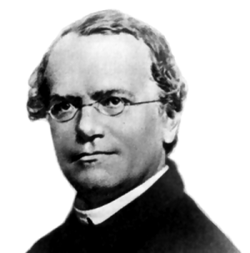
Gregor Mendel gave two lectures on his work in early 1865, presenting his findings on inheritance patterns in pea plants before publishing them formally.
Image source: Gregor Mendel

1866
Mendel's work was published in 1866 as 'Versuche über Pflanzen-Hybriden' (Experiments on Plant Hybridisation) in the Verhandlungen des Naturforschenden Vereins zu Brünn (Proceedings of the Natural History Society of Brünn), following two lectures he gave on the work in early 1865.
Image source: Experiments on Plant Hybridization

This History of Genetics timeline was generated with the help of AI, using information found on the internet.
We work hard to keep these timelines accurate, but mistakes do get through. If you spot one, email us at [email protected] and we'll fix it for future visitors.
Generate yours with AI or build it from scratch, for free.