-
Resources
-
Pricing
The history of gunpowder traces the invention, spread, and transformation of explosive chemical technology from medieval China into a powerful force that reshaped warfare, empires, industry, and modern society. More Less
Build a timeline like this one in minutes, for free. Start Yours →
Part of our collection of invention and technology timelines.
800 - 899
Chinese alchemists experimenting with sulfur, charcoal, and saltpeter created incendiary and explosive mixtures during the Tang dynasty. The earliest formulas were not yet standardized propellant, but they established the chemical foundation of gunpowder.
Image source: Gunpowder
1044
The Song military treatise Wujing Zongyao recorded several gunpowder recipes. Its formulas demonstrate that Chinese engineers understood controlled proportions of saltpeter, sulfur, and carbon for incendiaries, smoke devices, and explosives.
Image source: Wujing Zongyao
1230 - 1279
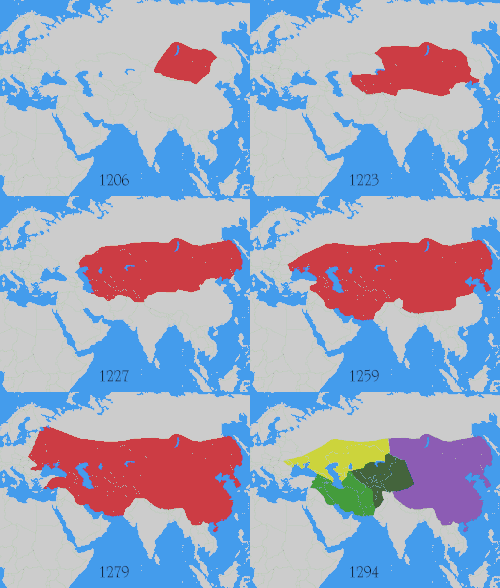
The Mongol conquests brought Chinese engineers, weapons, and military knowledge into contact with Central Asian, Middle Eastern, and European societies. Gunpowder devices and expertise circulated across the expanding Mongol world.
Image source: Mongol invasions and conquests
1300 - 1399
Gunpowder weapons and manufacturing knowledge spread westward through Mongol networks and trade routes. Islamic states adopted rockets, bombs, hand cannons, and siege guns, integrating them into established military traditions.
Image source: Early modern warfare
1543
Portuguese traders introduced matchlock guns, known in Japan as tanegashima, to the island of Tanegashima. Japanese smiths quickly copied the design, beginning a rapid transformation of warfare during the Sengoku period.
900 - 999
Song forces used arrows carrying gunpowder-filled tubes or incendiary charges. These fire arrows were among the earliest gunpowder weapons and combined conventional projectile technology with chemical propulsion or fire.
Image source: Fire arrow
1100 - 1199
Chinese soldiers developed the fire lance, a spear or pole with a gunpowder tube that projected flame, sparks, and sometimes fragments. It was a transitional weapon between incendiary devices and true firearms.
Image source: Fire lance
1126 - 1279
During conflicts between the Jin and Song states, Chinese armies deployed bombs, fire lances, rockets, and other gunpowder devices in sieges and field operations. These wars accelerated the practical development of explosive and incendiary weapons.
1221
Chinese accounts of the Jin siege of Qizhou describe thunder-crash bombs, iron or ceramic containers packed with gunpowder. Such weapons used explosive force and fragmentation against besieging or defending troops.
1300 - 1399
Small metal-barreled hand cannons emerged in China and later across Eurasia. Fired with a touch hole and an external ignition source, they were difficult to aim but introduced portable gunpowder firepower to infantry.
Image source: Hand cannon
1326
A European manuscript associated with Walter de Milemete contains an illustration of a vase-shaped cannon firing a bolt. It is one of the earliest securely dated artistic representations of a gun.
Aug 26, 1346
English forces reportedly used a small number of primitive cannons at Crécy during the Hundred Years' War. Their battlefield effect was limited, but the engagement is an early documented European use of artillery in a major battle.
Image source: Battle of Crécy
1400 - 1499
The matchlock mechanism allowed a smoldering cord to ignite gunpowder in a firearm's priming pan. It improved reliability and enabled soldiers to hold and aim weapons more effectively than earlier hand cannons.
Image source: Matchlock
1600 - 1625
The flintlock replaced the smoldering match with a flint striking steel to create sparks. Its faster ignition, resistance to weather, and simpler handling made it the dominant military firearm mechanism for roughly two centuries.
Image source: Flintlock
Jun 15, 1389
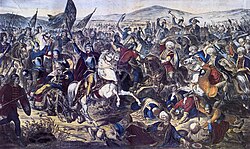
Ottoman forces used gunpowder artillery during the Battle of Kosovo. Cannon were becoming a regular component of Ottoman warfare and would later support the empire's major siege operations.
Image source: Battle of Kosovo
Apr 6, 1453 - May 29, 1453
Mehmed II's Ottoman army employed enormous bombards and numerous smaller cannon during the siege of Constantinople. The eventual breach of the city's walls became a landmark in the history of siege artillery.
Image source: Fall of Constantinople
Jul 17, 1453
French artillery played a decisive role at Castillon, helping defeat an English assault and effectively ending the Hundred Years' War. The battle showed how concentrated gunpowder artillery could dominate a fortified position.
Image source: Battle of Castillon
1500 - 1699
Low, thick bastions and angled walls evolved in response to powerful cannon. The trace italienne spread across Europe and made sieges longer, more technical, and more dependent on artillery and engineering.
1516 - 1517
Ottoman armies used field artillery and firearms extensively against the Mamluks. Their victories at Marj Dabiq and Ridaniya illustrated the military advantages of disciplined gunpowder forces over cavalry-centered armies.
1525
At the Battle of Pavia, Spanish and allied arquebusiers helped defeat French cavalry and demonstrated the growing importance of firearms in European combined-arms warfare. The arquebus increasingly supplemented pikes and crossbows.
Image source: Arquebus
May 18, 1565 - Sep 11, 1565
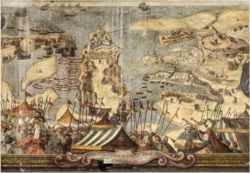
Ottoman and Hospitaller forces fought a major siege involving extensive cannon fire, mines, grenades, and firearms. The defenders' survival demonstrated the increasing interaction between gunpowder artillery and fortified architecture.
Image source: Great Siege of Malta
Jun 29, 1575
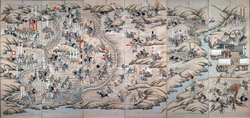
Oda Nobunaga's forces used rotating ranks of arquebusiers behind field fortifications against Takeda cavalry. Although later accounts may simplify the tactics, the battle symbolizes Japan's rapid adoption of matchlock firearms.
Image source: Battle of Nagashino
Jul 19, 1588 - Aug 8, 1588
English ships used naval guns, fireships, and maneuvering tactics against the Spanish Armada. Gunpowder artillery was central to the fleet actions and helped prevent the planned Spanish invasion of England.
Image source: Spanish Armada
1618 - 1648
The Thirty Years' War featured large professional armies equipped with muskets, pistols, field guns, and siege artillery. Its campaigns encouraged standardized logistics, drill, fortification, and state control of gunpowder warfare.
Image source: Thirty Years' War
1722 - 1854
The British Army and East India Company widely used the Land Pattern musket, commonly called the Brown Bess. Its standardized flintlock design equipped millions of soldiers and supported British imperial expansion.
1780 - 1799
The Kingdom of Mysore used iron-cased rockets effectively against British forces in the Anglo-Mysore Wars. Captured examples influenced British Congreve rockets and helped advance military rocket design.
Image source: Mysorean rockets
1804
William Congreve adapted and systematized Mysorean war-rocket technology for British military use. Congreve rockets had long range and psychological impact, although their accuracy was limited compared with conventional artillery.
Image source: Congreve rocket
1820 - 1829
The percussion cap used a shock-sensitive primer rather than a flint and steel. It made firearms more reliable in wet conditions and supported the transition toward percussion muskets, rifles, and revolvers.
1840 - 1869
The Minié ball allowed rifled muskets to load quickly while delivering much greater range and accuracy than smoothbore muskets. Their widespread use made infantry fire more lethal and changed battlefield tactics.
Oct 16, 1853 - Mar 30, 1856
The Crimean War featured modern rifled firearms, heavy siege guns, naval artillery, and industrial production. Its prolonged siege warfare exposed the destructive potential of improved gunpowder weapons and modern logistics.
Image source: Crimean War
Apr 12, 1861 - May 26, 1865
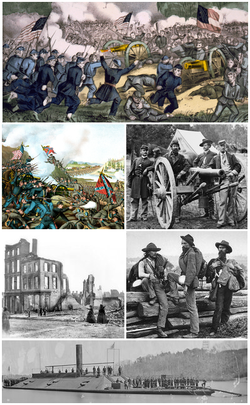
The American Civil War saw extensive use of rifled muskets, breechloaders, repeating arms, ironclad naval guns, and large siege artillery. Mass production and improved ammunition made gunpowder combat deadlier than in earlier wars.
Image source: American Civil War
1867
Alfred Nobel patented dynamite, stabilizing nitroglycerin with an absorbent material and making it safer to transport and use. Dynamite was not traditional gunpowder, but it marked the industrial shift from black powder toward high explosives.
Image source: Dynamite
1884
Paul Vieille developed Poudre B, generally regarded as the first successful modern smokeless powder. Based on nitrocellulose, it produced far less smoke and more energy than black powder, enabling smaller, faster, and more powerful firearms.
1884
Hiram Maxim developed the first successful self-powered machine gun. Using recoil to cycle the action and smokeless or improved propellants in later service, it greatly increased sustained battlefield firepower.
Image source: Maxim gun
1900 - 1999
During the twentieth century, nitrocellulose, nitroglycerin, composite propellants, and high explosives largely replaced traditional black powder in military applications. Black powder survived mainly in historic weapons, sport shooting, fireworks, and specialized uses.
Jul 28, 1914 - Nov 11, 1918
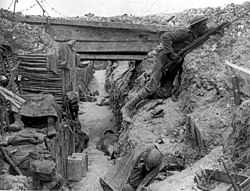
World War I made artillery the principal killer on many fronts. Industrial production supplied enormous quantities of shells, propellants, explosives, and ammunition, while trench warfare drove advances in mortars, machine guns, and heavy guns.
Image source: World War I
Sep 1, 1939 - Sep 2, 1945
World War II brought widespread use of smokeless propellants, shaped charges, rockets, grenades, automatic weapons, and mass-produced artillery ammunition. Gunpowder remained important, while high explosives and propellant chemistry became increasingly specialized.
Image source: World War II
Build a timeline like this one in minutes, for free. Start Yours →
Or browse the full history timeline directory, with more than 2,500 topics.
This History of Gunpowder timeline was generated with the help of AI, using information found on the internet.
We work hard to keep these timelines accurate, but mistakes do get through. If you spot one, email us at [email protected] and we'll fix it for future visitors.
Generate yours with AI or build it from scratch, for free.
Export your timeline, add your own events, edit or remove AI-generated events, and much more
No credit card required.
15-day money-back guarantee.
You can create an unlimited number of timelines with up to 10 events on each one, customize how they look, export them to PDF, PNG, PowerPoint, CSV, and Excel, and share them with a link. Timelines made with Timeline Maker AI keep every event the generator created, and you can add up to 5 events of your own. Paid plans remove the event limit, add spreadsheet imports and hide Preceden's branding, and the higher-priced plan also adds collaborators, a custom logo and a custom domain.
Yes. You can cancel your subscription from your account page at any time, and you will not be charged again. Your subscription stays active for the rest of the period you already paid for.
Yes. We email you a reminder 15 days before your annual renewal, and we email you a receipt after every payment.
Yes. You can email us within 15 days of any payment, and we will issue you a full refund.
Check out our pricing docs or send us an email anytime: [email protected].