-
Use Cases
-
Resources
-
Pricing
500 BCE - 401 BCE
% complete
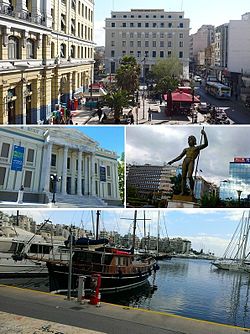
In the 5th century BC, Themistocles established a lighthouse at the harbour of Piraeus connected to Athens. It consisted essentially of a small stone column with a fire beacon.
Image source: Piraeus
300 BCE - 201 BCE
% complete
The Pharos of Alexandria was built in the 3rd century BC by the Greeks. Written descriptions and drawings of it provide key information about early lighthouses, though the tower itself collapsed during an earthquake many centuries after its construction.
Image source: Lighthouse of Alexandria
1350 - 1399
% complete
In the Late Middle Ages, Edward the Black Prince built a 40-foot (12 m) tower at Cordouan near the Gironde estuary, an early example of a purpose-built stone light tower.
Image source: Cordouan Lighthouse
1581
% complete
One hundred years after the Black Prince's tower, Henri III asked architect Louis de Foix to build a new lighthouse at Cordouan in 1581.
1611
% complete
Construction of Louis de Foix's new Cordouan Lighthouse took twenty-seven years and was finally completed in 1611, becoming one of the most celebrated lighthouses of its age.
1780 - 1790
% complete
Cordouan's upper level was rebuilt between 1780 and 1790, increasing its height from 49m to 60m and incorporating an Argand lamp and one of the first parabolic mirrors, turned by clockwork developed by a clockmaker in Dieppe.
1609
% complete
With increasing numbers of ships lost along the Newcastle to London coal route, Trinity House established the Lowestoft Lighthouse in 1609, consisting of a pair of wooden towers with candle illuminants.
Image source: Lowestoft Lighthouse
1696 - 1698
% complete
The modern era of lighthouse construction saw the first attempt on the Eddystone Rocks: an octagonal wooden structure anchored by 12 iron stanchions secured in the rock, built by Henry Winstanley from 1696 to 1698.
Image source: Eddystone Lighthouse
1703
% complete
Winstanley's Eddystone tower proved short-lived; the Great Storm of 1703 erased almost all trace of it, demonstrating the ferocity of the sea against early offshore lighthouses.
1708 - 1709
% complete
A temporary light was first shone from the new Eddystone tower in 1708 and work was completed in 1709. This proved more durable, surviving until 1755 when it burnt to the ground.
1732
% complete
The Nore lightship was established as the world's first floating light in 1732, extending navigational aids to waters where fixed towers could not be built.
Image source: Lightship
1756 - 1759
% complete
Civil engineer John Smeaton rebuilt the Eddystone Lighthouse from 1756 to 1759. His tower marked a major step forward in lighthouse design and remained in use until 1877.
1797
% complete
Scottish engineer Robert Stevenson was a seminal figure in lighthouse design and construction. In 1797 he was appointed engineer to the newly formed Northern Lighthouse Board, the lighthouse authority for Scotland and the Isle of Man.
Image source: Robert Stevenson (civil engineer)
1802
% complete
Abuse of private lighthouse licenses led foreign ships to fear seeking refuge on England's south coast. Most notably, the Dutch merchant ship Vreede was lost in 1802 with the loss of 380 lives.
Image source: Trinity House
1807 - 1810
% complete
Robert Stevenson's greatest achievement was the construction of the Bell Rock Lighthouse in 1810, one of the most impressive feats of engineering of the age and the oldest surviving sea-washed lighthouse in Britain.
Image source: Bell Rock Lighthouse
1810 - 1910
% complete
Robert Stevenson established a great dynasty of engineers specializing in lighthouse construction; his descendants were responsible for most of the lighthouse construction in Scotland for a century.
1836
% complete
The Lighthouse Act 1836 gave Trinity House powers to buy out the last private lighthouse owners and refurbish its estate. Trinity House spent over £1m buying back leases, including £444,000 for the Skerries Lighthouse.
1838 - 1841
% complete
Construction of the screw-pile design began in 1838 at the mouth of the Thames as the Maplin Sands lighthouse, which was first lit in 1841.
Image source: Screw-pile lighthouse
1840
% complete
Though its construction began later than the Maplin Sands lighthouse, the Wyre Light in Fleetwood, Lancashire, was the first to be lit, in 1840.
Image source: Wyre Light
1852
% complete
Even after the Lighthouse Act 1836 reforms, owners still collected large dues, the largest being for the Smalls Lighthouse, which collected £23,000 in 1852.
Image source: Smalls Lighthouse
1716
% complete
The first lighthouse in today's United States was Boston Light, built in 1716 at Boston Harbor, marking the start of American lighthouse history.
Image source: Boston Light
1764
% complete
Due to fire hazards with wooden structures, masonry towers were increasingly built. The oldest standing masonry tower is Sandy Hook Lighthouse, built in 1764 in New Jersey.
Image source: Sandy Hook Light
1790
% complete
The San Juan de Ulúa fortress Veracruz lighthouse (1790) was the first modern lighthouse in the American Spanish Empire, serving one of Spain's most important colonial ports.
Image source: San Juan de Ulúa
Mar 3, 1851
% complete
On March 3, 1851, the U.S. Congress acted to reform American lighthouse administration, creating the body that would oversee and modernize the nation's aids to navigation.
Image source: United States Lighthouse Board
1763
% complete
William Hutchinson developed the first practical optical system in 1763, known as a catoptric system, which used mirrors to concentrate and project lighthouse light more effectively.
Image source: Catoptrics
1782
% complete
The Argand lamp, invented in 1782 by Swiss scientist Aimé Argand, revolutionized lighthouse illumination with its steady, smokeless flame, replacing candles, coal, and wood fires.
Image source: Argand lamp
1783 - 1788
% complete
Until the late 18th century, candle, coal, or wood fires were used as lighthouse illuminants. The French conducted a series of tests between 1783 and 1788 with varying results, seeking better lighting methods.
Image source: Lighthouse
1784
% complete
The Argand lamp was first produced by Matthew Boulton, in partnership with Argand, in 1784, and became the standard for lighthouses for over a century.
1810
% complete
Smeaton's Eddystone lighthouse used 24 candles as its illuminant until 1810, illustrating how long traditional candle lighting persisted before newer technologies took hold.
1823
% complete
After the marquis de Condorcet proposed grinding such a lens from a single thin piece of glass, Augustin-Jean Fresnel developed his 'dioptric' lens system. The first Fresnel lens was used in 1823 in the Cordouan Lighthouse at the mouth of the Gironde estuary; its light could be seen from more than 20 miles (32 km) out.
Image source: Fresnel lens
1862
% complete
The first electrically illuminated lighthouse was the tower at Dungeness, Kent, in 1862, pioneering electric lighting for maritime navigation.
Image source: Dungeness Lighthouse
1865
% complete
Given a grant by the Dublin Ballast Board in 1865, Wigham fitted his new gas 'crocus' burner at the Baily Lighthouse in Howth Head, giving an output four times more powerful than equivalent oil lights.
Image source: Baily Lighthouse
1868
% complete
An improved 'composite' design was installed in the Baily light in 1868, judged 13 times more powerful than the most brilliant light then known by scientist John Tyndall, advisor to Trinity House.
1870
% complete
In 1870, the light at Wicklow Head was fitted with Wigham's patent intermittent flashing mechanism, which timed the gas supply by means of clockwork, enabling distinctive flashing characteristics.
Image source: Wicklow Head
1875
% complete
South Foreland Lighthouse became the first tower to successfully use an electric light in 1875, advancing the adoption of electric illumination in lighthouses.
Image source: South Foreland Lighthouses
1901
% complete
The vaporized oil burner was invented in 1901 by Arthur Kitson and later improved by David Hood at Trinity House, greatly increasing lighthouse brightness.
1906
% complete
In 1906, Dalén became chief engineer at the Gas Accumulator Company, where his innovations would further transform automatic lighthouse operation.
Image source: Gustaf Dalén
Or browse the full history timeline directory, with more than 2,000 topics.
This History of Lighthouses timeline was generated with the help of AI, using information found on the internet.
We work hard to keep these timelines accurate, but mistakes do get through. If you spot one, email us at [email protected] and we'll fix it for future visitors.
Generate yours with AI or build it from scratch, for free.
Export your timeline, add your own events, edit or remove AI-generated events, and much more
No credit card required.
Cancel anytime.
Cancel anytime.
You can create an unlimited number of timelines with up to 10 events on each one, customize how they look, export them to PDF, PNG, PowerPoint, CSV, and Excel, and share them with a link. Paid plans raise the event limit and add features like spreadsheet imports and collaborators.
Yes. You can cancel your subscription from your account page at any time, and you will not be charged again. Your subscription stays active for the rest of the period you already paid for.
Yes. We will email you a reminder before the annual renewal, and we will also email you a receipt.
Yes. You can email us within 15 days of any payment, and we will issue you a full refund.
Check out our pricing docs or send us an email anytime: [email protected].