-
Use Cases
-
Resources
-
Pricing
The history of plastics traces humanity's journey from using natural materials like rubber and shellac to inventing fully synthetic polymers. Beginning with celluloid in the 1860s and Leo Baekeland's Bakelite in 1907, plastics revolutionized manufacturing, medicine, packaging, and everyday life throughout the 20th century, while the 21st century brings new focus on sustainability, recycling, and biodegradable alternatives. More Less
1800 - 1899
% complete
In the nineteenth century, as chemistry developed during the Industrial Revolution, many new materials were reported, laying the groundwork for the birth of the plastics industry.
Image source: Industrial Revolution
1839
% complete
The development of plastics accelerated with Charles Goodyear's 1839 discovery of vulcanization, a process to harden natural rubber that made it far more durable and useful.
Image source: Charles Goodyear
1855
% complete
Parkesine, invented by Alexander Parkes in 1855 and patented the following year, is considered the first man-made plastic.
Image source: Celluloid
1862
% complete
Parkesine was unveiled at the 1862 International Exhibition in London and garnered for Parkes the bronze medal, introducing man-made plastic to the public.
1872
% complete
Polyvinyl chloride (PVC) was first created in 1872, though it was not commercially produced until the late 1920s as one of the earliest wave of new polymers.
Image source: Polyvinyl chloride
1893
% complete
In 1893, French chemist Auguste Trillat discovered the means to insolubilize casein (milk proteins) by immersion in formaldehyde, producing material marketed as galalith.
Image source: Galalith
1897
% complete
In 1897, mass-printing press owner Wilhelm Krische of Hanover, Germany, was commissioned to develop an alternative to blackboards. The resultant horn-like plastic made from casein was developed in cooperation with Austrian chemist Adolph Spitteler.
1907
% complete
The world's first fully synthetic plastic was Bakelite, invented in New York in 1907 by Leo Baekeland, who also coined the term plastics. Bakelite launched the age of fully synthetic polymers.
Image source: Bakelite
1923
% complete
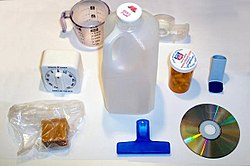
In 1923, Durite Plastics, Inc., became the first manufacturer of phenol-furfural resins, expanding the commercial range of synthetic resin products.
Image source: Plastic
1927
% complete
Although polyvinyl chloride was first created in 1872, it began to be commercially produced in the late 1920s, becoming one of the world's most widely used plastics.
1930 - 1939
% complete
Among the earliest examples in the wave of new polymers was polystyrene, first produced by BASF in the 1930s, which would become one of the most widely used commodity plastics.
Image source: Polystyrene
1933
% complete
In 1933, polyethylene was discovered by Imperial Chemical Industries (ICI) researchers Reginald Gibson and Eric Fawcett, leading to one of the most important plastics in history.
Image source: Polyethylene
1941
% complete
The discovery of polyethylene terephthalate (PETE) is credited to employees of the Calico Printers' Association in the UK in 1941; it was licensed to DuPont for the US and ICI otherwise, and its suitability as a glass replacement led to widespread use for bottles in Europe.
Image source: Polyethylene terephthalate
1954
% complete
Also in 1954, expanded polystyrene, used for building insulation, packaging, and cups, was invented by Dow Chemical.
1954
% complete
In 1954 polypropylene was discovered by Giulio Natta and began to be manufactured in 1957, becoming one of the world's leading petrochemical-derived polyolefins.
Image source: Polypropylene
1950 - 2017
% complete
Between 1950 and 2017, an estimated 9.2 billion metric tons of plastic were made, with more than half of this amount being produced since 2004, illustrating the explosive growth of the industry.
1950 - 1959
% complete
Since the birth of the plastic industry in the 1950s, global production has increased enormously, transforming manufacturing, packaging, and everyday life worldwide.
2010
% complete
Since 2010 Asia has emerged as a significant producer, with China accounting for 31% of total plastic resin production in 2020, shifting the center of global plastic manufacturing eastward.
Image source: Plastics industry
2010
% complete
Since 2010, over US$200 billion has been invested in the United States in new plastic and chemical plants, stimulated by the low cost of raw materials such as shale gas.
2016
% complete
In China in 2016 there were over 15,000 plastic manufacturing companies, generating more than US$366 billion in revenue, underscoring the scale of the Chinese plastics sector.
2017
% complete
In 2017, the global plastics market was dominated by thermoplastics—polymers that can be melted and recast—which are prized for their recyclability and versatility.
Image source: Thermoplastic
2000
% complete
From 2000 to the present, bioplastics from renewable sources and awareness of microplastics have spurred extensive research and policies to control plastic pollution.
Image source: Bioplastic
2009
% complete
In 2009, the US government banned certain types of phthalates commonly used in plastic, responding to concerns about their effects on human health.
Image source: Phthalates
Jan 2010
% complete
As of January 2010, the Los Angeles Times reported that the US Food and Drug Administration (FDA) is spending $30 million to investigate indications of BPA's link to cancer, raising health concerns about common plastics.
Image source: Bisphenol A
2018
% complete
In 2018 more than 343 million tons of plastic waste were generated, 90% of which was composed of post-consumer plastic waste from industrial, agricultural, commercial, and municipal sources.
Image source: Plastic pollution
Mar 2, 2022
% complete
On March 2, 2022, UN Member States voted at the resumed fifth UN Environment Assembly (UNEA-5.2) to establish an Intergovernmental Negotiating Committee (INC) with the mandate of advancing a legally-binding international agreement on plastics.
Image source: United Nations Environment Programme
2023
% complete
In 2023, plasticosis, a new disease caused by the ingestion of plastic waste, was discovered in seabirds, highlighting the direct biological harm of plastic pollution on wildlife.
Image source: Plasticosis
2024
% complete
A study from 2024 found that compared to glass and aluminum, plastic may actually have less of a negative effect on the environment and therefore might be the best option for most food packaging and other common uses.
2025
% complete
In 2025, for the first time in history almost every country discussed not just recycling but reducing plastic production itself, marking a historic shift in global environmental policy.
Or browse the full history timeline directory, with more than 2,000 topics.
This History of Plastics timeline was generated with the help of AI, using information found on the internet.
We work hard to keep these timelines accurate, but mistakes do get through. If you spot one, email us at [email protected] and we'll fix it for future visitors.
Generate yours with AI or build it from scratch, for free.
Export your timeline, add your own events, edit or remove AI-generated events, and much more
No credit card required.
Cancel anytime.
Cancel anytime.
You can create an unlimited number of timelines with up to 10 events on each one, customize how they look, export them to PDF, PNG, PowerPoint, CSV, and Excel, and share them with a link. Paid plans raise the event limit and add features like spreadsheet imports and collaborators.
Yes. You can cancel your subscription from your account page at any time, and you will not be charged again. Your subscription stays active for the rest of the period you already paid for.
Yes. We will email you a reminder before the annual renewal, and we will also email you a receipt.
Yes. You can email us within 15 days of any payment, and we will issue you a full refund.
Check out our pricing docs or send us an email anytime: [email protected].