-
Use Cases
-
Resources
-
Pricing
The history of logic traces the development of reasoning and argumentation from ancient Greece, India, and China through medieval scholasticism, the algebraic logic of Boole, and the revolutionary formal systems of Frege, Russell, and Gödel, culminating in modern mathematical and computational logic. More Less
1000 BC
% complete
Esagil-kin-apli's medical Diagnostic Handbook in the 11th century BC was based on a logical set of axioms and assumptions, while Babylonian astronomers in the 8th and 7th centuries BC employed an internal logic within their predictive planetary systems, an important contribution to the philosophy of science.
Image source: History of logic

520 BC
% complete
Early Greek thinkers such as the Pythagoreans in the late sixth century BC showed concern with the principles of reasoning, laying groundwork for later Greek logical traditions.
500 BC
% complete
The Mahabharata (12.173.45), around the 5th century BC, refers to the anviksiki and tarka schools of logic, providing early evidence of systematic logical thought in ancient India.
500 BC
% complete
Pāṇini (c. 5th century BC) developed a form of logic (to which Boolean logic has some similarities) for his formulation of Sanskrit grammar.
430 BC
% complete
Stoic logic traces its roots back to the late 5th century BC philosopher Euclid of Megara, a pupil of Socrates and slightly older contemporary of Plato, probably following in the tradition of Parmenides and Zeno.
Image source: Stoicism
400 BC
% complete
Further evidence that early Greek thinkers were concerned with the principles of reasoning is found in the fragment called dissoi logoi, probably written at the beginning of the fourth century BC.
Image source: Dissoi logoi
400 BC - 347 BC
% complete
None of the surviving works of the great fourth-century philosopher Plato (428–347 BC) include any formal logic, but they include important contributions to the field of philosophical logic.
Image source: Plato
300 BC
% complete
The two most important dialecticians of the Megarian school were Diodorus Cronus and Philo, who were active in the late 4th century BC, contributing significantly to the development of propositional logic that would influence the Stoics.
300 BC - 300 AD
% complete
For centuries after Stoic logic had been formulated, it was the dominant system of logic in the classical world, emphasizing propositions and inference over Aristotle's term-based syllogistic.
200 AD
% complete
The Nyaya Sutras (2nd century AD) constitute the core texts of the Nyaya school, one of the six orthodox schools of Hindu philosophy, establishing a lasting tradition of Indian logic.
Image source: Nyaya

524 AD
% complete
Christian philosophers such as Boethius (died 524), through translations and commentaries, preserved and transmitted Aristotle's logic to the medieval West, shaping scholastic philosophy for centuries.
Image source: Boethius
600 AD - 1100 AD
% complete
Until the twelfth century, the only works of Aristotle available in the West were the Categories, On Interpretation, and Boethius's translation of the Isagoge of Porphyry (a commentary on the Categories).
1142 AD
% complete
An important work in the medieval logical tradition was the Logica Ingredientibus of Peter Abelard (1079–1142), which made significant contributions to the theory of universals and semantics.
Image source: Peter Abelard
1200 AD
% complete
The proof for the principle of explosion, also known as the principle of Pseudo-Scotus, according to which any proposition can be proven from a contradiction, was first given by the 12th century French logician William of Soissons.
1250 AD
% complete
By the early thirteenth century, the remaining works of Aristotle's Organon, including the Prior Analytics, Posterior Analytics, and the Sophistical Refutations (collectively known as the Logica Nova or 'New Logic'), had been recovered in the West.
Image source: Organon
1274 AD
% complete
Christian philosophers such as Thomas Aquinas (died 1274) further developed Aristotle's logic in the Middle Ages, incorporating it deeply into theology and natural philosophy.
Image source: Thomas Aquinas
1347 AD
% complete
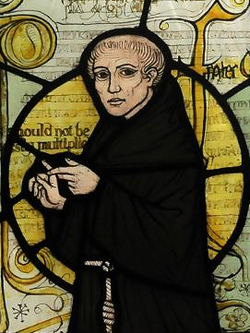
William of Ockham (died 1347) further developed Aristotle's logic in the Middle Ages, contributing influential work on supposition theory and terminism within scholastic logic.
Image source: William of Ockham
1358 AD
% complete
Christian and Islamic philosophers further developed Aristotle's logic in the Middle Ages, reaching a high point in the mid-fourteenth century with Jean Buridan, whose work on sophismata and consequences marked the peak of scholastic logic.
Image source: Jean Buridan
1037 AD
% complete
Ibn Sina (Avicenna) (980–1037) was the founder of Avicennian logic, which replaced Aristotelian logic as the dominant system of logic in the Islamic world, and also had an important influence on Western medieval writers such as Albertus Magnus.
Image source: Avicenna
1149 AD
% complete
Al-Ghazali (1058–1111, died 1111; his influential critique appeared by 1149 in later works' reception) criticised Aristotle's 'first figure' and formulated an early system of inductive logic, foreshadowing the system of inductive logic developed by John Stuart Mill (1806–1873).
Image source: Al-Ghazali
1191 AD
% complete
The Illuminationist school was founded by Shahab al-Din Suhrawardi (1155–1191), who developed the idea of 'decisive necessity', referring to the reduction of all modalities (necessity, possibility, contingency and impossibility) to the single mode of necessity.
1204 AD
% complete
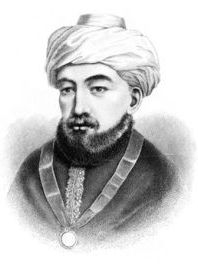
Maimonides (1138-1204) wrote a Treatise on Logic (Arabic: Maqala Fi-Sinat Al-Mantiq), referring to Al-Farabi as the 'second master', the first being Aristotle.
Image source: Maimonides
1249 AD
% complete
Fakhr al-Din al-Razi (1149–1249) developed a form of logic revolving around the subject matter of conceptions and assents, influencing later Islamic logical thought.
1274 AD
% complete
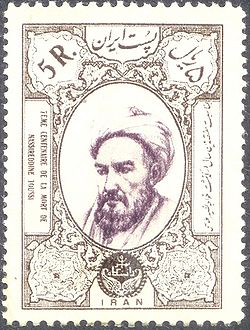
In response to the Post-Avicennian school, Nasir al-Din al-Tusi (1201–1274) began a tradition of Neo-Avicennian logic which remained faithful to Avicenna's work and existed as an alternative to the more dominant Post-Avicennian school over the following centuries.
Image source: Nasir al-Din al-Tusi
1288 AD
% complete
Ibn al-Nafis (1213–1288) wrote a book on Avicennian logic, which was a commentary of Avicenna's Al-Isharat (The Signs) and Al-Hidayah (The Guidance).
Image source: Ibn al-Nafis
1350 AD - 1800 AD
% complete
The period between the fourteenth century and the beginning of the nineteenth century saw largely decline and neglect, and at least one historian of logic regards this time as barren, though thousands of pages on logic were still written, especially in the Islamic world.
1600 AD - 1733 AD
% complete
The last great works in the scholastic tradition are the Logic of John Poinsot (1589–1644, known as John of St Thomas), the Metaphysical Disputations of Francisco Suarez (1548–1617), and the Logica Demonstrativa of Giovanni Girolamo Saccheri (1667–1733).
Image source: John of St. Thomas
1620 AD
% complete
Empirical methods ruled the day, as evidenced by Sir Francis Bacon's Novum Organon of 1620, an influential work proposing induction as the foundation of scientific reasoning.
Image source: Novum Organum
1662 AD
% complete
Published in 1662, the Port-Royal Logic was the most influential work on logic after Aristotle until the nineteenth century. Between 1664 and 1700, there were eight editions, and the book had considerable influence after that.
Image source: Port-Royal Logic
1725 AD - 1843 AD
% complete
Other works in the textbook tradition include Isaac Watts's Logick: Or, the Right Use of Reason (1725), Richard Whately's Logic (1826), and John Stuart Mill's A System of Logic (1843), which treated logic largely as a descriptive science.
Image source: A System of Logic
1817 AD
% complete
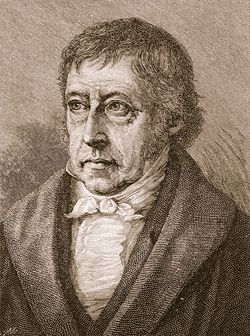
Hegel indicated the importance of logic to his philosophical system when he condensed his extensive Science of Logic into a shorter work published in 1817 as the first volume of his Encyclopaedia of the Philosophical Sciences.
Image source: Science of Logic
1850 AD
% complete
Logic revived in the mid-nineteenth century, at the beginning of a revolutionary period when the subject developed into a rigorous and formal discipline which took as its exemplar the exact method of proof used in mathematics, a hearkening back to the Greek tradition.
1855 AD - 1867 AD
% complete
Carl von Prantl's Geschichte der Logik im Abendland (1855–1867) provided a major historical survey of Western logic, reflecting renewed scholarly interest in the discipline during its revival period.
Image source: Karl von Prantl
1883 AD
% complete
Bradley's Principles of Logic (1883) was an important idealist contribution to logic during the era when logic was widely treated as a descriptive science and branch of psychology.
Image source: F. H. Bradley
1816 AD
% complete
Gergonne said that reasoning does not have to be about objects about which one has perfectly clear ideas, because algebraic operations can be carried out without having any idea of the meaning of the symbols involved — an early anticipation of symbolic logic.
Image source: Joseph Diez Gergonne
1847 AD
% complete
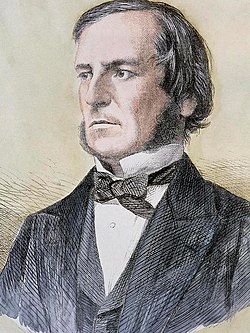
The algebraic school begins with Boole's seminal work Mathematical Analysis of Logic which appeared in 1847, although De Morgan (1847) is its immediate precursor. The success of Boole's algebraic system suggested that all logic must be capable of algebraic representation.
Image source: George Boole
1864 AD
% complete
Jevons published Pure Logic, or the Logic of Quality apart from Quantity in 1864, where he suggested a symbol to signify exclusive or, which allowed Boole's system to be greatly simplified.
Image source: William Stanley Jevons
1867 AD
% complete
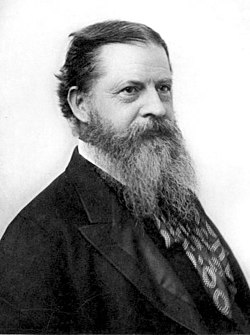
Boole's early work lacked the idea of the logical sum which originates in Peirce (1867), Schröder (1877) and Jevons (1890), and the concept of inclusion, first suggested by Gergonne (1816) and clearly articulated by Peirce (1870).
Image source: Charles Sanders Peirce
1869 AD
% complete
In 1869 Jevons realised that Boole's methods could be mechanised, and constructed a 'logical machine' which he showed to the Royal Society the following year. In 1885 Allan Marquand proposed an electrical version of the machine that is still extant.
Image source: Logical machine
1881 AD
% complete
In his Symbolic Logic (1881), John Venn used diagrams of overlapping areas to express Boolean relations between classes or truth-conditions of propositions, creating what are now known as Venn diagrams.
Image source: John Venn
1890 AD - 1905 AD
% complete
Schröder's monumental Vorlesungen über die Algebra der Logik ('Lectures on the Algebra of Logic', vol iii 1895) ambitiously expressed a logic of relations in algebraic form. He set out theorems in parallel columns in this work (1890–1905).
Image source: Ernst Schröder (mathematician)
1900 AD
% complete
Between the work of Mill and Frege, logic was widely treated as a descriptive science, essentially a branch of psychology. It was subjected to an extended and destructive critique by Edmund Husserl in the first volume of his Logical Investigations (1900), an assault described as 'overwhelming'.
1901 AD
% complete
The logicist project received a near-fatal setback with the discovery of a paradox in 1901 by Bertrand Russell, showing that naive set theory leads to contradiction.
Image source: Russell's paradox
1910 AD - 1913 AD
% complete
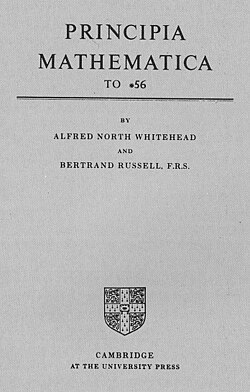
The monumental Principia Mathematica, a three-volume work on the foundations of mathematics, written by Russell and Alfred North Whitehead and published 1910–1913 included an attempt to resolve the paradox by means of an elaborate system of types: one cannot speak of the 'set of all sets'.
Image source: Principia Mathematica
1910 AD - 1939 AD
% complete
The metamathematical period from 1910 to the 1930s saw the development of metalogic, in the finitist system of Hilbert, and the non-finitist systems of Löwenheim and Skolem, culminating in the combination of logic and metalogic in the work of Gödel and Tarski.
Image source: Metamathematics
1913 AD
% complete
Peirce (1880) showed how all Boolean elective functions could be expressed using a single primitive binary operation, 'neither...nor...', but like many of Peirce's innovations, this remained unknown until Sheffer rediscovered it in 1913.
1929 AD
% complete
Work on metamathematics culminated in the work of Gödel, who in 1929 showed that a given first-order sentence is deducible if and only if it is logically valid, establishing the completeness of first-order predicate logic.
Image source: Gödel's completeness theorem
1931 AD
% complete
Gödel's incompleteness theorem of 1931 was one of the greatest achievements in the history of logic, showing that any consistent formal system capable of arithmetic contains true statements that cannot be proved within the system.
1933 AD
% complete
In 1933, Tarski published (in Polish) The concept of truth in formalized languages, in which he proposed his semantic theory of truth: a sentence such as 'snow is white' is true if and only if snow is white. According to Anita Feferman, Tarski 'changed the face of logic in the twentieth century'.
1936 AD - 1937 AD
% complete
Alonzo Church and Alan Turing proposed formal models of computability, giving independent negative solutions to Hilbert's Entscheidungsproblem in 1936 and 1937 respectively, founding theoretical computer science.
1950 AD
% complete
Progress in mathematical logic in the first few decades of the twentieth century, particularly arising from the work of Gödel and Tarski, had a significant impact on analytic philosophy and philosophical logic, particularly from the 1950s onwards, in subjects such as modal logic, temporal logic, deontic logic, and relevance logic.
1963 AD
% complete
Paul Cohen introduced forcing in 1963 to prove the independence of the continuum hypothesis and the axiom of choice from Zermelo–Fraenkel set theory, earning him the Fields Medal.
Image source: Forcing (mathematics)
1965 AD
% complete
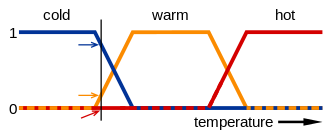
Another logical system founded after World War II was fuzzy logic by Azerbaijani mathematician Lotfi Asker Zadeh in 1965, allowing reasoning with degrees of truth rather than strict true/false values.
Image source: Fuzzy logic
1980 AD
% complete
Saul Kripke's best known and most influential work is Naming and Necessity (1980), which reshaped analytic philosophy of language and revitalized modal logic.
Image source: Naming and Necessity
Or browse the full history timeline directory, with more than 2,000 topics.
This History of Logic timeline was generated with the help of AI, using information found on the internet.
We work hard to keep these timelines accurate, but mistakes do get through. If you spot one, email us at [email protected] and we'll fix it for future visitors.
Generate yours with AI or build it from scratch, for free.
Export your timeline, add your own events, edit or remove AI-generated events, and much more
No credit card required.
Cancel anytime.
Cancel anytime.
You can create an unlimited number of timelines with up to 10 events on each one, customize how they look, export them to PDF, PNG, PowerPoint, CSV, and Excel, and share them with a link. Paid plans raise the event limit and add features like spreadsheet imports and collaborators.
Yes. You can cancel your subscription from your account page at any time, and you will not be charged again. Your subscription stays active for the rest of the period you already paid for.
Yes. We will email you a reminder before the annual renewal, and we will also email you a receipt.
Yes. You can email us within 15 days of any payment, and we will issue you a full refund.
Check out our pricing docs or send us an email anytime: [email protected].