-
Use Cases
-
Resources
-
Pricing
1600 - 1899
Chapbooks and similar inexpensive publications provided accessible reading across England over several centuries. Their circulation contributed to the spread of popular reading and everyday print culture.
1600 - 1899
Simple reading matter became commonplace across England from the 17th to the 19th century. These inexpensive forms of print helped make reading material available beyond elite and institutional settings.
Image source: Chapbook
1800 - 1899
Reading became more pronounced in the 19th century as public notes, broadsides, catchpennies, and printed songs became common street literature. These forms made printed material visible and accessible in public spaces.
1800 - 1899
During the 19th century, printed songs helped inform and entertain the public. They circulated as part of street literature before newspapers became readily available.
1800 - 1899
Broadsides and related printed forms served public reading needs before newspapers were readily available. Their role demonstrates how people encountered news, entertainment, and information through ephemeral print.
1700 - 1799
During the 18th century, reading alone in bed became a new practice in parts of Europe. Some people considered it dangerous and immoral, reflecting anxieties about private reading and changing habits of leisure.
1700 - 1799
In 18th-century England, reading novels was often criticized as a time-wasting pastime. Critics contrasted novels with history, classical literature, and poetry, which were regarded as culturally serious forms of reading.
1800 - 1899
Reading in 19th-century Russia ranged from high literature to the peasant lubok. The coexistence of these materials shows that reading culture included both prestigious literary works and popular visual or inexpensive print.
1800 - 1899
In 19th-century Russia, reading practices were highly varied. People from a wide range of social statuses encountered texts in different languages and formats, reflecting a broad and socially diverse reading culture.
1800 - 1899
Nineteenth-century Russian readers read both Russian and foreign-language texts. This multilingual reading environment expanded the range of literary and informational material available to different communities.
1700 - 1749
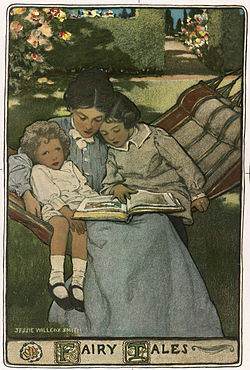
Before the mid-18th century, children’s books in England usually focused on instruction or religious themes. Reading for children was therefore commonly presented as a means of moral, educational, or spiritual development.
1750 - 1799
Children’s novels became increasingly popular during the 18th century. Their growth illustrates the broader shift from predominantly instructional children’s books toward literature designed to engage young readers through narrative.
1750 - 1799
Over the course of the 18th century, more books were written with the intention of delighting children. This marked a growing recognition of entertainment as a legitimate purpose of children’s reading.
Image source: Children's literature
1800
By 1800, children’s literature was flourishing. Major cities may have printed as many as 50 children’s books every year, indicating a substantial and growing market for young readers.
1900 - 2099
In the 20th and 21st centuries, audiobooks became increasingly popular as a way of engaging with books and other texts through listening.
2000 - 2099
In the 21st-century United States, public libraries have helped make audiobooks available to readers and listeners. Library access is part of the broader technological and institutional expansion of audiobook use.
Image source: Audiobook
2000 - 2099
The popularity of audiobooks in the 21st century has been linked in part to technological advances that make audio materials widely available for download.
Apr 23, 1968
In his 1968 address on human rights, René Maheu identified the ability to read as a necessary foundation. The statement placed reading at the beginning of broader participation in human rights and society.
Apr 23, 1968
On April 23, 1968, UNESCO Director-General René Maheu spoke at the International Conference on Human Rights organized by the United Nations. He stated that “One must first be able to read,” connecting literacy with the exercise of human rights.
Image source: Right to education
2000
The US National Reading Panel reported in 2000 that proficient reading of alphabetic languages requires several key elements: phonemic awareness, phonics, fluency, vocabulary, and text comprehension.
2000
The 2000 report of the US National Reading Panel identified phonemic awareness as one of the elements required for proficient reading of alphabetic languages.
2000
The US National Reading Panel listed phonics among the essential elements of proficient reading in alphabetic languages. Its inclusion emphasized the relationship between written symbols and speech sounds.
Image source: National Reading Panel
2000
Reading fluency was named by the 2000 National Reading Panel as a required element of proficient reading of alphabetic languages.
2000
The National Reading Panel identified vocabulary as one of the central elements required for proficient reading in alphabetic languages.
2000
Text comprehension was included in the 2000 National Reading Panel’s list of elements required for proficient reading of alphabetic languages.
2005
In 2005, the Australian government published a report on reading and literacy. The report stated that the evidence was clear, presenting its conclusions as evidence-based guidance for reading instruction.
Nov 9, 2012
On November 9, 2012, the Supreme Court of Canada unanimously recognized that learning to read is not a privilege but a basic and essential human right.
Nov 9, 2012
The Supreme Court of Canada reached a unanimous decision in 2012 concerning access to learning to read. The decision framed reading instruction as part of a basic educational entitlement.
2017
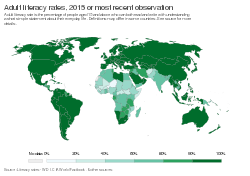
According to UNESCO figures cited by the International Literacy Association, 250 million children around the world lacked basic literacy skills in 2017.
Image source: Literacy
2017
The International Literacy Association characterized the global lack of basic literacy skills as an issue of social justice, emphasizing that unequal access to literacy affects rights and opportunity.
2022
In the United States, it was reported in 2022 that fewer than half of adults said they had read a book during the previous 12 months. The statistic highlights contemporary changes in adult reading participation.
Or browse the full history timeline directory, with more than 2,500 topics.
This History of Reading timeline was generated with the help of AI, using information found on the internet.
We work hard to keep these timelines accurate, but mistakes do get through. If you spot one, email us at [email protected] and we'll fix it for future visitors.
Generate yours with AI or build it from scratch, for free.
Export your timeline, add your own events, edit or remove AI-generated events, and much more
No credit card required.
Cancel anytime.
Cancel anytime.
You can create an unlimited number of timelines with up to 10 events on each one, customize how they look, export them to PDF, PNG, PowerPoint, CSV, and Excel, and share them with a link. Paid plans raise the event limit and add features like spreadsheet imports and collaborators.
Yes. You can cancel your subscription from your account page at any time, and you will not be charged again. Your subscription stays active for the rest of the period you already paid for.
Yes. We will email you a reminder before the annual renewal, and we will also email you a receipt.
Yes. You can email us within 15 days of any payment, and we will issue you a full refund.
Check out our pricing docs or send us an email anytime: [email protected].