-
Use Cases
-
Resources
-
Pricing
Timbuktu, founded around 1100 CE in present-day Mali, rose to prominence as a major center of trans-Saharan trade in gold, salt, and books, and became a renowned hub of Islamic learning under the Mali and Songhai Empires, home to institutions like Sankore University. Its decline began with Moroccan invasion in 1591, and it later faced European exploration, colonial rule, and recent conflicts, while its ancient manuscripts remain symbols of African intellectual heritage. More Less
1100
% complete
When Abd al-Sadi wrote his chronicle Tarikh al-Sudan in the 17th century, he dated the foundation of Timbuktu as a seasonal camp to 'the end of the fifth century of the hijra', around 1100 AD. Al-Sadi saw the Maghsharan Tuareg as the founders, whose summer encampment grew from a temporary settlement into a depot and travellers' meeting place.
Image source: Timbuktu
1300
% complete
The seasonal Tuareg or Berber settlement became a permanent town either in the 13th or early 14th century, as the summer encampment of the Maghsharan Tuareg grew from temporary settlement to depot to travellers' meeting place.
1324
% complete
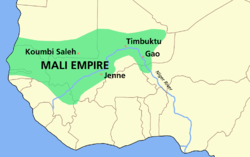
Timbuktu was peacefully annexed by Mansa Musa I when returning from his pilgrimage to Mecca in 1324, becoming part of the Mali Empire early in the 14th century.
Image source: Mali Empire
1350
% complete
Timbuktu developed as a commercial and religious centre in the 14th century as Walata, the previous hub of trans-Saharan trade in the region, declined. After a shift in trading routes, the town flourished from the trade in salt, gold, ivory and slaves from towns such as Begho of Bonoman, Sijilmassa and other Saharan cities.
Image source: Trans-Saharan trade
1353
% complete
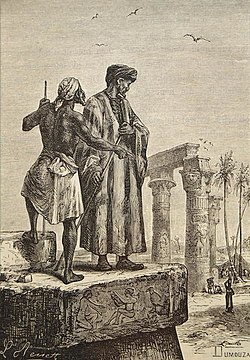
The Moroccan traveler Ibn Battuta visited both Timbuktu and Kabara in 1353 while returning from a stay in the capital of the Mali Empire. He met the governor, Farba Musa, and noted that most of the inhabitants were Massufa Berbers despite the town being under Malian rule. His account is the first known mention of the city.
Image source: Ibn Battuta
1375
% complete
In 1375, Timbuktu appeared in the Catalan Atlas, showing that it was by then a commercial centre linked to the North-African cities and had caught Europe's attention.
Image source: Catalan Atlas
1433 - 1468
% complete
With the power of the Mali Empire waning in the first half of the 15th century, Timbuktu became relatively autonomous, although Maghsharan Tuareg had a dominating position. The Tuareg tribes took control of the city for a short period until the expanding Songhai Empire absorbed it.
1468
% complete
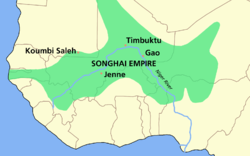
Thirty years after the Tuareg takeover, the rising Songhai Empire expanded and absorbed Timbuktu in 1468 or 1469, beginning an era in which the city was led consecutively by Sunni Ali Ber (1468–1492), Sunni Baru (1492–1493) and Askia Mohammad I (1493–1528).
Image source: Songhai Empire
1500 - 1600
% complete
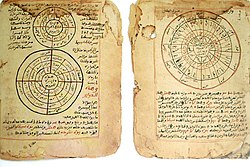
In its Golden Age in the 16th century, the town's numerous Islamic scholars and extensive trading network made possible an important book trade, making Timbuktu a renowned centre of learning.
Image source: Timbuktu Manuscripts
1512
% complete
During Timbuktu's Golden Age, the Andalusi author Leo Africanus visited the town in 1512 and gave a description of it in his Descrittione dell'Africa, published in 1550, which spread the city's fabled reputation across Europe.
Image source: Leo Africanus
1570
% complete
In 1570 Qadi al-Aqib had the mosque pulled down and rebuilt on a larger scale, reflecting the city's prosperity during the Songhai era.
May 30, 1591
% complete
The Moroccan army defeated the Songhai at the Battle of Tondibi, and the city was captured on 30 May 1591 by an expedition of mercenaries dubbed the Arma. The Moroccans made Timbuktu, rather than Gao, their capital.
Image source: Battle of Tondibi
1593
% complete
In 1593, Ahmad I al-Mansur cited 'disloyalty' as the reason for arresting, and subsequently killing or exiling, many of Timbuktu's scholars, including Ahmad Baba, who later returned to Timbuktu where he died in 1627.
Image source: Ahmad Baba al-Timbukti
1600
% complete
The earliest surviving local documents are the 17th century chronicles, al-Sadi's Tarikh al-Sudan and Ibn al-Mukhtar's Tarikh al-fattash, which provide information on the town at the time of the Songhai Empire and the Moroccan invasion of 1591. The Tarikh al-fattash ends in around 1600.
Image source: Tarikh al-fattash
1612
% complete
The invaders established a new ruling class, the Arma, who after 1612 became virtually independent of Morocco, though the grip of subsequent pashas on the city gradually weakened.
1655
% complete
Al-Sadi's Tarikh al-Sudan, based on oral tradition, continues its account to 1655, providing valuable information on Timbuktu under Songhai rule and the Moroccan invasion.
Image source: Tarikh al-Sudan
1737
% complete
After Morocco cut its ties with the Arma, the grip of the pashas weakened: Tuareg temporarily took over control in 1737, and the remainder of the 18th century saw various Tuareg tribes, Bambara and Kounta briefly occupy or besiege the city.
1750
% complete
Information on Timbuktu after 1655 is provided by the Tadhkirat al-Nisyan (A Reminder to the Obvious), an anonymous biographical dictionary of the Moroccan rulers of Timbuktu written in around 1750.
1826 - 1865
% complete
This changed in 1826, when the Massina Empire took over control of the city until 1865, when they were driven away by the Toucouleur Empire.
Image source: Caliphate of Hamdullahi
1780
% complete
Over two and a half centuries after Leo Africanus, another notable account was given in 1780 by the Moroccan author Shabeni, who described Timbuktu at a very different point in its history.
1788
% complete
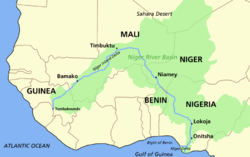
Historic descriptions of the city prompted several European individuals and organizations to seek Timbuktu and its fabled riches. In 1788 a group of titled Englishmen formed the African Association with the goal of finding the city and charting the course of the Niger River.
Image source: African Association
1795 - 1805
% complete
The earliest explorer sponsored by the African Association was the young Scottish adventurer Mungo Park, who made two trips in search of the Niger River and Timbuktu, departing first in 1795 and then in 1805.
Image source: Mungo Park (explorer)
1812
% complete
The American sailor Robert Adams claimed to have visited Timbuktu in 1812, while he was enslaved for several years in Northern Africa.
Image source: Robert Adams (sailor)
1824
% complete
In 1824, the Paris-based Société de Géographie offered a 9,000 franc prize to the first non-Muslim to reach Timbuktu and return with information about it.
Image source: Société de Géographie
Aug 1826 - Sep 1826
% complete
The Scotsman Gordon Laing arrived in August 1826 but was killed the following month by local Muslims who were fearful of European intervention.
Image source: Alexander Gordon Laing
1828
% complete
The Frenchman René Caillié arrived in 1828 travelling alone, disguised as a Muslim; he was able to safely return and claim the Société de Géographie prize.
Image source: René Caillié
1853
% complete
Three Europeans reached the city before 1890: Heinrich Barth in 1853, and the German Oskar Lenz with the Spaniard Cristobal Benítez in 1880. Barth's account became one of the most detailed European descriptions of the city.
Image source: Heinrich Barth
Dec 15, 1893
% complete
On 15 December 1893, the city, by then long past its prime, was annexed by a small group of French soldiers led by Lieutenant Gaston Boiteux. Different tribes had governed the city until the French takeover.
1899
% complete
In 1899 the French Sudan was subdivided and Timbuktu became part of Upper Senegal and Middle Niger (Haut-Sénégal et Moyen Niger), beginning a series of colonial administrative reorganizations.
1902
% complete
In 1902 the name of the colony became Senegambia and Niger (Sénégambie et Niger), and in 1904 this was changed again to Upper Senegal and Niger (Haut-Sénégal et Niger).
Image source: Senegambia and Niger
1920
% complete
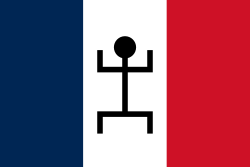
The name Upper Senegal and Niger was used until 1920, when the territory once again became French Sudan, with Timbuktu remaining within its borders.
Image source: French Sudan
Oct 1941 - Aug 1942
% complete
In October 1941 the Vichy French authorities transferred a group of interned British Merchant Navy seafarers from Conakry to Timbuktu. By May 1942 two crew members had died of disease there, and in August 1942 the French moved Criton's crew to Kankan.
Sep 22, 1960
% complete
After a period as part of the short-lived Mali Federation, the Republic of Mali was proclaimed on 22 September 1960, ending the colonial era and making Timbuktu part of the current Republic of Mali.
Image source: Mali
Nov 19, 1968 - 1974
% complete
After 19 November 1968, a new constitution was created in 1974, making Mali a single-party state.
Image source: History of Mali
1973 - 1985
% complete
Severe droughts hit the Sahel region in 1973 and 1985, decimating the Tuareg population around Timbuktu who relied on goat herding.
Image source: Droughts in the Sahel
1998 - 2009
% complete
Despite its illustrious history, as of 2009 Timbuktu was an impoverished town, poor even by Third World standards. The population grew an average 5.7% per year from 29,732 in 1998 to 54,453 in 2009.
2002
% complete
One such event damaged a World Heritage property in Timbuktu, killing two people and injuring one in 2002.
Mar 21, 2012
% complete
Following increasing frustration within the armed forces over the government's ineffective strategies against a Tuareg rebellion in northern Mali, a military coup on 21 March 2012 overthrew President Amadou Toumani Touré and overturned the 1992 constitution.
Image source: 2012 Malian coup d'état
Apr 1, 2012
% complete
The Tuareg rebels of the MNLA and Ansar Dine took advantage of the confusion following the coup to make swift gains, and on 1 April 2012, Timbuktu was captured from the Malian military.
Image source: Mali War
Apr 3, 2012
% complete
On 3 April 2012, the BBC News reported that the Islamist rebel group Ansar Dine had started implementing its version of sharia in Timbuktu.
Image source: Ansar Dine
Apr 6, 2012
% complete
The MNLA declared the independence of Azawad, containing Timbuktu, from Mali on 6 April 2012, but was rapidly pushed aside by Islamist movements Ansar Dine and AQMI, who installed sharia in the city and destroyed some of the burial chambers.
Image source: Azawad
Jan 28, 2013
% complete
On 28 January 2013, French and Malian soldiers reclaimed Timbuktu with little or no resistance and reinstalled Malian governmental authorities.
Image source: Operation Serval
Mar 21, 2013
% complete
On 21 March 2013 a suicide bomber detonated his explosives, killing a Malian soldier and creating a fierce shoot-out at the international airport which resulted in the killing of ten rebels.
Mar 31, 2013
% complete
On 31 March 2013, a group of 20 rebels infiltrated into Timbuktu as civilians and attacked the Malian army base in the city, killing three Malian soldiers and injuring dozens more.
Or browse the full history timeline directory, with more than 2,000 topics.
This History of Timbuktu timeline was generated with the help of AI, using information found on the internet.
We work hard to keep these timelines accurate, but mistakes do get through. If you spot one, email us at [email protected] and we'll fix it for future visitors.
Generate yours with AI or build it from scratch, for free.
Export your timeline, add your own events, edit or remove AI-generated events, and much more
No credit card required.
Cancel anytime.
Cancel anytime.
You can create an unlimited number of timelines with up to 10 events on each one, customize how they look, export them to PDF, PNG, PowerPoint, CSV, and Excel, and share them with a link. Paid plans raise the event limit and add features like spreadsheet imports and collaborators.
Yes. You can cancel your subscription from your account page at any time, and you will not be charged again. Your subscription stays active for the rest of the period you already paid for.
Yes. We will email you a reminder before the annual renewal, and we will also email you a receipt.
Yes. You can email us within 15 days of any payment, and we will issue you a full refund.
Check out our pricing docs or send us an email anytime: [email protected].