-
Use Cases
-
Resources
-
Pricing
Mansa Musa was the ruler of the Mali Empire in West Africa from approximately 1312 to 1337 CE. Renowned as possibly the wealthiest person in history, he expanded his empire's territory, promoted Islam, and famously undertook a lavish pilgrimage (hajj) to Mecca in 1324–1325, distributing so much gold along the way that he caused inflation in Cairo. His reign marked a golden age for Mali, with flourishing trade, scholarship in Timbuktu, and monumental architecture. More Less
1280
% complete
Mansa Musa was born around 1280 in the Mali Empire. The exact date of his birth is unknown, but he appears to have been a young man by 1324, when he undertook his famous pilgrimage to Mecca.
Image source: Mansa Musa
1312
% complete
Musa became the ninth Mansa of the Mali Empire. Under his rule, the empire reached its territorial peak, becoming one of the largest and most powerful states in West Africa.
1312 - 1337
% complete
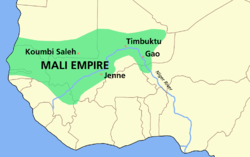
During Musa's reign, the Mali Empire reached its territorial peak, controlling vast territories across West Africa and dominating the trans-Saharan trade routes in gold and salt.
Image source: Mali Empire
1324
% complete
In 1324, while in Cairo during his pilgrimage, Musa stated that he had conquered 24 cities and their surrounding districts, underscoring the vast extent of his empire.
1330
% complete
In 1330, the kingdom of Mossi invaded and conquered the city of Timbuktu, striking at one of the crown jewels of the Mali Empire during Musa's era.
Image source: Mossi Kingdoms
1332
% complete
Al-Umari claimed that Musa returned to Mali intending to abdicate and live in Mecca but died before he could do so, suggesting he may have died even earlier than 1332.
1332
% complete
Using the reign lengths reported by Ibn Khaldun to calculate back from the death of Mansa Suleyman in 1360, Musa would have died in 1332, though other evidence points to a later date.
1337
% complete
Nehemia Levtzion regarded 1337 as the most likely date of Musa's death, a view accepted by many other scholars, based partly on Ibn Khaldun's account of the Tlemcen envoy exchange.
1337
% complete
Following Musa's death, Suleyman took the throne of the Mali Empire. Ibn Khaldun notes that by the time Abu al-Hasan's responding envoy arrived, Suleyman was already ruling.
Image source: Sulayman of Mali
May 1337
% complete
According to Ibn Khaldun, Musa sent an envoy to congratulate Abu al-Hasan Ali on his conquest of Tlemcen, which took place in May 1337. By the time Abu al-Hasan sent a reply, Musa had died and Suleyman was on the throne.
Image source: Abu al-Hasan Ali ibn Uthman
1324
% complete
Musa set out on Hajj to Mecca in 1324, traveling with an enormous entourage and a vast supply of gold. The journey would become legendary for its opulence and its impact on economies along the route.
1324 - 1325
% complete
Musa made his pilgrimage between 1324 and 1325, spanning 2700 miles across the Sahara and through Egypt to Arabia, one of the most remarkable royal journeys of the medieval world.
Jul 1324
% complete
Musa and his enormous entourage arrived at the outskirts of Cairo in July 1324. His lavish spending of gold there reportedly destabilized the local economy for years afterward.
Jul 1324 - 1325
% complete
During his stay in Cairo, Musa distributed so much gold that its value reportedly depreciated, an economic effect remembered for over a decade and recorded by contemporary chroniclers such as al-Umari.
1325
% complete
Musa completed the Hajj in Mecca in 1325, fulfilling one of the Five Pillars of Islam and cementing his reputation as a devout and extraordinarily wealthy Muslim monarch.
1325
% complete
After completing the Hajj, Musa returned to Mali in 1325, bringing back scholars, ideas, and architectural ambitions that would transform cities such as Timbuktu and Gao.
1325
% complete
The Granadan poet Abū Isḥāq al-Sāḥilī is commonly credited as the principal designer of Musa's building projects in Timbuktu, including the Djinguereber Mosque, though modern scholarship questions this narrative.
Image source: Al-Sahili
1325
% complete
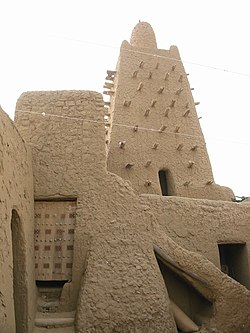
According to a long-standing tradition in nineteenth- and twentieth-century historiography, Musa brought architects from Andalusia and Cairo to build his palace in Timbuktu and the great Djinguereber Mosque, which still stands today.
Image source: Djinguereber Mosque
1977 - 1981
% complete
Excavations at Djenné-Djenno by Susan and Roderick McIntosh established that permanent settlement, complex craft production and iron metallurgy existed in the Inland Niger Delta by the third century BCE, showing the infrastructure behind Musa's building program drew on an ancient indigenous tradition.
Image source: Djenné-Djenno
1990
% complete
Architectural historian Labelle Prussin argued that the earthen banco architecture of the Niger bend, with its projecting toron beams, represents a centuries-long synthesis of indigenous West African and Islamic design practices rather than an importation from al-Andalus or the Maghreb.
Image source: Sudano-Sahelian architecture
2000
% complete
Modern scholarship regards the image of al-Sāḥilī as the founder of West African mosque architecture as a historiographical myth rather than an established historical fact, revising older narratives about Musa's building program.
1337
% complete
The Egyptian scholar al-Umari, writing approximately twelve years after Musa's hajj in about 1337, documented the pilgrimage based on accounts gathered in Cairo, providing one of the key primary sources on Musa.
1394
% complete
Ibn Khaldun reported the reign lengths of the mansas of Mali, including Musa. Using these figures to calculate back from the death of Mansa Suleyman in 1360 suggests Musa would have died in 1332.
Image source: Ibn Khaldun
1655
% complete
The Tarikh al-Sudan, a 17th-century chronicle written in Timbuktu, provides additional information about Mansa Musa and the history of the Mali Empire and the Songhai state that followed it.
Image source: Tarikh al-Sudan
1660
% complete
The Tarikh Ibn al-Mukhtar, another 17th-century manuscript written in Timbuktu, is one of two major local chronicles that supply additional information about Mansa Musa's life and reign.
Image source: Tarikh al-fattash
1339
% complete
Angelino Dulcert's 1339 map began a European cartographic tradition of showcasing a wealthy west African monarch, inspired by tales of Mansa Musa's hajj and his fabled gold.
Image source: Angelino Dulcert
1375
% complete
The 1375 Catalan Atlas famously depicts Mansa Musa enthroned and holding a gold nugget or scepter, describing him as 'the richest man in the region', though making no claim he was 'the richest in the world' or 'the richest in history'.
Image source: Catalan Atlas
1490
% complete
In the late 15th century, the Portuguese were attaining 400–550 kilos (880–1,200 pounds) of gold per year from the west African region through trade, reflecting the enduring gold wealth of the area once ruled by Musa.
Image source: Portuguese Empire
1525
% complete
In 1525, Sicilian mapmaker Jacopo Russo created the Mansa Musa Map in honor of the great emperor, continuing the European fascination with the wealthy ruler of Mali.
Image source: Jacopo Russo
2019
% complete
While several online articles in the 21st century have claimed Mansa Musa was the richest person of all time, historians such as Hadrien Collet have argued that his wealth is impossible to calculate accurately.
2020
% complete
Historians regard converting Musa's wealth into modern monetary equivalents as methodologically unsound, given the gap between fourteenth-century Sahelian gold-economy logic and modern asset valuation, and the difficulty of separating a monarch's personal wealth from that of the state.
Or browse the full history timeline directory, with more than 2,000 topics.
This Mansa Musa timeline was generated with the help of AI, using information found on the internet.
We work hard to keep these timelines accurate, but mistakes do get through. If you spot one, email us at [email protected] and we'll fix it for future visitors.
Generate yours with AI or build it from scratch, for free.
Export your timeline, add your own events, edit or remove AI-generated events, and much more
No credit card required.
Cancel anytime.
Cancel anytime.
You can create an unlimited number of timelines with up to 10 events on each one, customize how they look, export them to PDF, PNG, PowerPoint, CSV, and Excel, and share them with a link. Paid plans raise the event limit and add features like spreadsheet imports and collaborators.
Yes. You can cancel your subscription from your account page at any time, and you will not be charged again. Your subscription stays active for the rest of the period you already paid for.
Yes. We will email you a reminder before the annual renewal, and we will also email you a receipt.
Yes. You can email us within 15 days of any payment, and we will issue you a full refund.
Check out our pricing docs or send us an email anytime: [email protected].