
-
Use Cases
-
Resources
-
Pricing
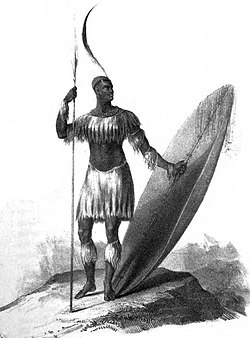
Shaka Zulu (c. 1787–1828) was one of the most influential monarchs in African history, transforming the Zulu people from a small clan into a powerful kingdom through revolutionary military tactics, including the 'buffalo horns' formation and the short stabbing spear (iklwa). His reign reshaped southern Africa during the Mfecane period. More Less
1700
% completado
Using a standard formula of eighteen years per reign, the historian Bryant calculated that the eponymous chief Zulu had died at the beginning of the eighteenth century, establishing the lineage from which Shaka would later descend.
Image source: Shaka
Jul, 1787
% completado
King Shaka was born in the lunar month of uNtulikazi (July) in 1787, in Mthonjaneni, KwaZulu-Natal Province, South Africa. He was the son of Chief Senzangakhona and would go on to become one of the most influential monarchs in southern African history.
1816
% completado
Shaka kaSenzangakhona became king of the Zulu Kingdom in 1816. Over his twelve-year reign he transformed the Zulu into the dominant military power in southern Africa through sweeping military and social reforms.
1815 - 1840
% completado
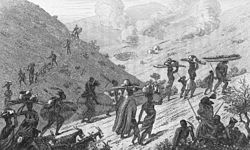
King Shaka's reign coincided with the start of the Mfecane/Difaqane ('upheaval' or 'crushing'), a period of devastating warfare and chaos in southern Africa between 1815 and 1840 that depopulated much of the region.
Image source: Mfecane
1816 - 1840
% completado
The ripple effect caused by mass migrations during Shakan times spread across southern Africa. These movements would become known, though only in the twentieth century, as the Mfecane/Difaqane (annihilation).
1816 - 1828
% completado
By the time of Shaka's assassination in 1828, his military system had made the Zulu kingdom the greatest power in southern Africa and a force to be reckoned with, even against Britain's modern army in 1879.
1825
% completado
It was not until around 1825 that Shaka and the Ndwandwe leader Zwide, two major military leaders, met in the vicinity of Pongola, near the present-day border of Mpumalanga, a province of South Africa.
1826
% completado
Shaka later had to contend again with Zwide's son, Sikhunyane, in 1826, continuing the struggle with the Ndwandwe polity that had become one of the Zulu kingdom's most serious rivals.
1827 - 1836
% completado
Modern archaeology of the village of Lepalong confirms accounts of the disruption of Shakan times: it was an entire settlement built underground to shelter remnants of the Kwena people from 1827 to 1836 against the tide of disruption engulfing the region.
1879
% completado
The second major clash for the Zulu kingdom came against the British during 1879, roughly half a century after Shaka's death, demonstrating the enduring military strength of the state he had built even against Britain's modern army.
Image source: Anglo-Zulu War
Oct, 1827
% completado
Shaka's mother, Nandi, died in October 1827. Her death devastated Shaka, whose subsequent erratic behavior caused enormous suffering in the Zulu kingdom and contributed to the conditions leading to his assassination.
1828
% completado
After Shaka's assassination, his half-brother Dingane seized the throne. Dingane ruled for some twelve years, during which time he fought, disastrously, against the Voortrekkers and against another half-brother, Mpande.
Image source: Dingane
Sep 24, 1828
% completado
In 1828, Shaka was assassinated at kwaDukuza by his half-brothers King Dingane and Prince Mhlangana, together with Mbopha kaSithayi. September 24 is the most frequently cited date, when almost all available Zulu manpower had been sent on yet another mass sweep to the north.
Image source: Shaka
1840
% completado
In 1840, Mpande, another half-brother of Shaka, took over the Zulu leadership with Boer and British support, ruling for some thirty years after displacing Dingane.
Image source: Mpande kaSenzangakhona
1836
% completado
Nathaniel Isaacs published his Travels and Adventures in Eastern Africa in 1836, creating a picture of Shaka as a degenerate and pathological monster which survives in modified forms to this day.
Image source: Nathaniel Isaacs
1892
% completado
Shaka features in Nada the Lily (1892), an historical adventure novel by Sir H. Rider Haggard, one of the earliest works of fiction centered on the Zulu king.
Image source: Nada the Lily
1900
% completado
Around 1900, James Stuart collected the rich resource of oral histories about Shaka and the Zulu kingdom. These accounts may be balanced against the biased written records of Isaacs and Fynn, and were later published in six volumes as The James Stuart Archive.
Image source: James Patrick Stuart
1950
% completado
Isaacs had been aided in his portrayal of Shaka by Henry Francis Fynn, whose diary — actually a rewritten collage of various papers — was edited by James Stuart only in 1950, long after the events it described.
1955
% completado
Ritter's novel Shaka Zulu (1955), a pot-boiling romance, was re-edited into something more closely resembling a history, further shaping popular perceptions of the Zulu king.
Image source: John Ritter
1986
% completado
Shaka Zulu, a 10-part 1986 SABC TV miniseries about Shaka, starred Henry Cele in the title role and brought the story of the Zulu king to a worldwide television audience.
1998
% completado
A 1998 study by historian Carolyn Hamilton summarizes much of the scholarship on Shaka towards the dawn of the 21st century, covering areas ranging from ideology, politics and culture to the use of his name and image in the South African theme park Shakaland.
2004
% completado
uShaka Marine World, an aquatic theme park on the Durban beach front named in reference to Shaka, opened in 2004, continuing the king's presence in South African public culture.
Image source: UShaka Marine World
May 1, 2010
% completado
The King Shaka International Airport at La Mercy, 35 km (22 mi) north of the Durban city centre, opened on 1 May 2010 in preparation for the 2010 FIFA World Cup, after a protracted debate over the naming of the airport.
Image source: King Shaka International Airport
Or browse the full history timeline directory, with more than 2,000 topics.
This Shaka Zulu timeline was generated with the help of AI, using information found on the internet.
We work hard to keep these timelines accurate, but mistakes do get through. If you spot one, email us at [email protected] and we'll fix it for future visitors.
Generate yours with AI or build it from scratch, for free.
Export your timeline, add your own events, edit or remove AI-generated events, and much more
No credit card required.
Cancel anytime.
Cancel anytime.
You can create an unlimited number of timelines with up to 10 events on each one, customize how they look, export them to PDF, PNG, PowerPoint, CSV, and Excel, and share them with a link. Paid plans raise the event limit and add features like spreadsheet imports and collaborators.
Yes. You can cancel your subscription from your account page at any time, and you will not be charged again. Your subscription stays active for the rest of the period you already paid for.
Yes. We will email you a reminder before the annual renewal, and we will also email you a receipt.
Yes. You can email us within 15 days of any payment, and we will issue you a full refund.
Check out our pricing docs or send us an email anytime: [email protected].