-
Use Cases
-
Resources
-
Pricing
This timeline covers the major events and developments in the ancient civilization of Mesopotamia, including the emergence of city-states, the invention of writing, and the establishment of powerful empires. More Less
Build a timeline like this one in minutes, for free. Start Yours →
Part of our collection of ancient history timelines.
4000 BC - 599 BC
The art of Mesopotamia rivalled that of Ancient Egypt as the most grand, sophisticated and elaborate in western Eurasia from the 4th millennium BC until the Persian Achaemenid Empire conquered the region in the 6th century BC.
Image source: Art of Mesopotamia

2650 BC
The art of Mesopotamia produced several iconic pieces, including the two figures of a Ram in a Thicket, the Copper Bull, and a bull's head on one of the Lyres of Ur.
Image source: Lyres of Ur

1069 BC - 1046 BC
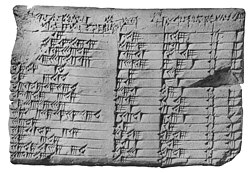
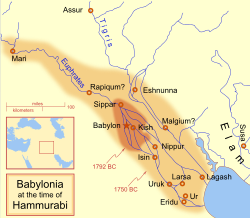
The most extensive Babylonian medical text, the Diagnostic Handbook, was written by the ummânū, or chief scholar, Esagil-kin-apli of Borsippa, during the reign of the Babylonian king Adad-apla-iddina (1069–1046 BC).
Image source: Babylonia
800 BC - 699 BC
During the 8th and 7th centuries BC, Babylonian astronomers developed a new approach to astronomy.
Image source: Babylonian astronomy

700 BC - 601 BC
According to a recent hypothesis, the Archimedes' screw may have been used by Sennacherib, King of Assyria, for the water systems at the Hanging Gardens of Babylon and Nineveh in the 7th century BC.
Image source: Archimedes' screw

3200 BC
These arguments were recorded in tablets several hundreds of years before any major war—the first recording of a war occurred around 3200 BC but was not common until about 2500 BC.
3100 BC
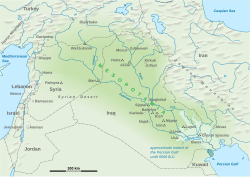
The Sumerians and Akkadians, originating from different areas, dominated Mesopotamia from the beginning of recorded history until the fall of Babylon in 539 BC.
Image source: History of Mesopotamia
2600 BC
Eventually Sumer was unified by Eannatum, but the unification was tenuous and failed to last as the Akkadians conquered Sumer in 2331 BC only a generation later.
Image source: Eannatum

2600 BC
Gilgamesh, a historical king of the Sumerian city-state of Uruk (ca. 2700 BC), was commended for military exploits against Humbaba, guardian of the Cedar Mountain, and was later celebrated in many later poems and songs in which he was claimed to be two-thirds god and only one-third human.
Image source: Epic of Gilgamesh

1780 BC
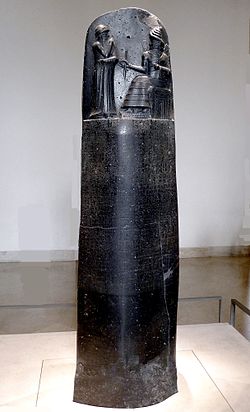
The most renowned of these was that of Hammurabi, as mentioned above, who was posthumously famous for his set of laws, the Code of Hammurabi (created c. 1780 BC), which is one of the earliest sets of laws found and one of the best preserved examples of this type of document from ancient Mesopotamia.
Image source: Code of Hammurabi
Build a timeline like this one in minutes, for free. Start Yours →
This Mesopotamia timeline was generated with the help of AI, using information found on the internet.
We work hard to keep these timelines accurate, but mistakes do get through. If you spot one, email us at [email protected] and we'll fix it for future visitors.
Generate yours with AI or build it from scratch, for free.