
-
Use Cases
-
Resources
-
Pricing
Sargon of Akkad (also known as Sargon the Great) was a ancient Mesopotamian ruler who founded the Akkadian Empire, widely considered the world's first empire. Rising from humble origins—legend claims he was a cupbearer to the king of Kish—Sargon conquered the Sumerian city-states and unified much of Mesopotamia under his rule, establishing an empire that stretched from the Persian Gulf to the Mediterranean Sea. More Less
2334 BC
% complete
Sargon of Akkad, also known as Sargon the Great, rises to power as the first ruler of the Akkadian Empire, beginning a reign that would last until 2279 BC in the middle chronology.
Image source: Sargon of Akkad
2334 BC - 2330 BC
% complete
In his first years on the throne, Sargon consolidates his control over the city of Akkad and its surrounding territory, building the base for future conquests.
Image source: Akkadian Empire
2334 BC
% complete
Sargon founds the 'Sargonic' or 'Old Akkadian' dynasty, which will rule for about a century after his death until the Gutian conquest of Sumer.
2334 BC - 2325 BC
% complete
Later tradition preserved in the Sargon Birth Legend asserts that the great king was the illegitimate son of a priestess, an infant exposure story echoed in later literature.
Image source: Sargon of Akkad
2320 BC - 2300 BC
% complete
Throughout his reign Sargon commissions inscriptions celebrating his conquests, creating a written record that later generations would remember and embellish.
2314 BC - 2300 BC
% complete
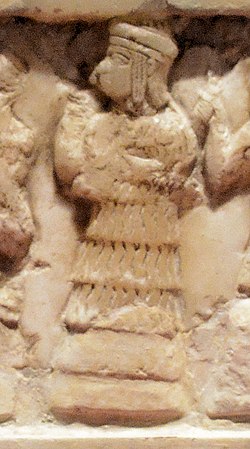
Works associated with Sargon's court circle, including the Exaltation of Inanna attributed to his daughter Enheduanna, remain in use for centuries thereafter.
Image source: Enheduanna
2310 BC - 2290 BC
% complete
Sargon and his successors come to be regarded as 'deified kings', an idea later recalled in Hurro-Hittite song and Bronze Age oral tradition about 'Sargonic heroes'.
2300 BC - 2279 BC
% complete
Later scribal tradition records the duration of Sargon's reign as 55 years, though scholars argue this may be a corruption of an original figure of 37 years.
2279 BC
% complete
Sargon dies in 2279 BC after a reign of decades, leaving the Akkadian Empire to his heirs and beginning roughly a century of Sargonic dynastic rule.
2279 BC
% complete
Following Sargon's death, his descendants continue the Old Akkadian dynasty, including his grandson Naram-Sin, whose memory blends with Sargon's in later tradition.
2279 BC
% complete
After his death Sargon appears as a legendary figure whose deeds are retold for millennia, from Neo-Assyrian literature to modern film and music referencing his name.
2332 BC
% complete
Sargon launches his famous conquests of the Sumerian city-states, beginning the military campaigns that define his rule in the 24th century BC.
2331 BC
% complete
Among Sargon's early victories is the conquest of Uruk, one of the most important Sumerian city-states, bringing it under Akkadian control.
Image source: Uruk
2330 BC
% complete
Sargon's armies continue southward, defeating the powerful southern Sumerian cities of Ur and Lagash and extending Akkadian authority over lower Mesopotamia.
2329 BC
% complete
Sargon defeats Lugalzagesi, the king of Umma who had briefly unified Sumer, removing the last major obstacle to Akkadian domination of the region.
Image source: Lugal-zage-si
2326 BC - 2324 BC
% complete
Sargon extends his reach toward the Persian Gulf, securing trade routes and asserting dominance over the regions along Mesopotamia's southeastern frontier.
Image source: Persian Gulf
2324 BC - 2320 BC
% complete
Sargon leads military expeditions north and west into upper Mesopotamia, expanding the young empire beyond the alluvial plains of Sumer and Akkad.
Image source: Upper Mesopotamia
2318 BC - 2312 BC
% complete
The subjugated Sumerian cities periodically revolt against Akkadian rule, and Sargon campaigns repeatedly to suppress these uprisings and reassert control.
2308 BC - 2300 BC
% complete
In his later years Sargon continues to defend the empire's borders, campaigning against peoples on the periphery to preserve the unity of his realm.
2328 BC
% complete
Having subdued the Sumerian city-states, Sargon achieves a unification of Babylonia, heralding the history of Semitic empires in the Ancient Near East.
2328 BC - 2320 BC
% complete
Sargon organizes his conquered territories under centralized Akkadian administration, installing loyal officials and standardizing governance across the empire.
2328 BC
% complete
Under Sargon, the Semitic Old Akkadian tongue gains prestige as the language of the empire, used alongside Sumerian in royal inscriptions and records.
Image source: Akkadian language
2322 BC - 2315 BC
% complete
During this period Sargon secures control of vital trade routes linking Mesopotamia with neighboring regions, enriching the Akkadian state.
2320 BC - 2310 BC
% complete
To hold his vast conquests, Sargon stations garrisons in key cities throughout the empire, integrating the former Sumerian city-states into a single realm.
2315 BC
% complete
As part of royal piety, votive gifts are deposited at temples such as the temple of Shamash in Sippar, echoing objects like the mace-head associated with Sargonic kingship.
2312 BC
% complete
By the height of his reign, Sargon rules an empire stretching across Mesopotamia, the first true empire known to history and a model for later Semitic powers.
2285 BC - 2279 BC
% complete
In the closing years of his life Sargon oversees a stable if restive empire, having transformed the landscape of the Ancient Near East through his conquests.
Or browse the full history timeline directory, with more than 2,000 topics.
This Sargon of Akkad timeline was generated with the help of AI, using information found on the internet.
We work hard to keep these timelines accurate, but mistakes do get through. If you spot one, email us at [email protected] and we'll fix it for future visitors.
Generate yours with AI or build it from scratch, for free.
Export your timeline, add your own events, edit or remove AI-generated events, and much more
No credit card required.
Cancel anytime.
Cancel anytime.
You can create an unlimited number of timelines with up to 10 events on each one, customize how they look, export them to PDF, PNG, PowerPoint, CSV, and Excel, and share them with a link. Paid plans raise the event limit and add features like spreadsheet imports and collaborators.
Yes. You can cancel your subscription from your account page at any time, and you will not be charged again. Your subscription stays active for the rest of the period you already paid for.
Yes. We will email you a reminder before the annual renewal, and we will also email you a receipt.
Yes. You can email us within 15 days of any payment, and we will issue you a full refund.
Check out our pricing docs or send us an email anytime: [email protected].