-
Use Cases
-
Resources
-
Pricing
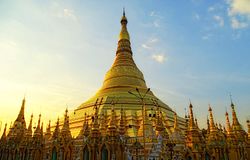
The Shwedagon Pagoda, located in Yangon, Myanmar (formerly Rangoon, Burma), is one of the most sacred Buddhist sites in the world. Standing approximately 99 meters (326 feet) tall and gilded with real gold plates and topped with thousands of diamonds and gems, it is believed to enshrine relics of the four previous Buddhas. The pagoda has been a center of Buddhist worship and Burmese national identity for centuries. More Less
1362
% complete
The first mention of the pagoda in the royal chronicles dates only to 1362/63 CE (724 ME), marking the earliest documented reference to this sacred Buddhist site in Burma.
1362
% complete
King Binnya U of Martaban–Hanthawaddy raised the pagoda to a height of 18 m (59 ft), an early major expansion of the stupa recorded in the chronicles.
1436
% complete
A record from the reign of Queen Shin Sawbu (1454–1471) shows a list of repairs of the pagoda going back to 1436, documenting ongoing maintenance of the shrine.
1454 - 1471
% complete
Queen Shin Sawbu (r. 1454–1471) raised the height of the pagoda to 40 m (130 ft) and gilded the new structure, greatly enhancing its prominence.
1485
% complete
The Mon King Dhammazedi donated the Great Bell of Dhammazedi, weighing 300 tons, one of the largest bells ever cast, to the Shwedagon Pagoda.
1500
% complete
By the beginning of the 16th century, Shwedagon Pagoda had become the most famous Buddhist pilgrimage site in Burma, drawing devotees from across the region.
1600 - 1767
% complete
A series of earthquakes during the centuries between the early 17th century and the mid-18th century caused significant damage to the Shwedagon Pagoda.
Image source: Shwedagon Pagoda
1608
% complete
In 1608 the Portuguese adventurer Filipe de Brito e Nicote, known as Nga Zinka to the Burmese, plundered the Shwedagon Pagoda.
Image source: Filipe de Brito e Nicote
1608
% complete
De Brito's men took the 300-ton Great Bell of Dhammazedi with the intention of melting it down for cannons; the bell famously sank while being carried away and was never recovered.
Image source: Great Bell of Dhammazedi
1768
% complete
The worst damage in the pagoda's history was caused by a 1768 earthquake that brought down the top of the stupa.
1775
% complete
Following the earthquake of 1768, King Hsinbyushin raised the pagoda to its current height of 99 m (325 ft), not counting the height of the hti (crown umbrella).
1779
% complete
The Maha Gandha (great sweet sound) Bell, a 23-ton bronze bell popularly known as the Singu Min Bell, was cast in 1779 and donated by King Singu.
1871
% complete
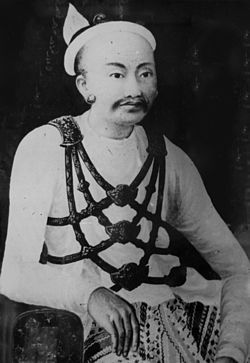
A new hti was donated by King Mindon in 1871, nearly two decades after the annexation of Lower Burma by the British.
Image source: Mindon Min
1796
% complete
Hiram Cox, the British envoy to the Burmese Court, observed the tradition by not visiting the pagoda rather than take off his shoes, highlighting early colonial friction over customs at the shrine.
1824
% complete
The great Buddhist shrine had been fortified by British troops in the 1824 war, converting the sacred precincts into a military position.
May 11, 1824
% complete
Two centuries after de Brito's plunder, the British landed on May 11, 1824, during the First Anglo-Burmese War, occupying the area around the pagoda.
Image source: First Anglo-Burmese War
1841
% complete
King Tharrawaddy Min donated the 42-ton Tharrawaddy Min Bell along with 20 kg of gold plating; this massive ornate bell hangs in its pavilion in the northeast corner of the stupa.
Image source: Tharrawaddy Min
1852
% complete
Having been fortified by the British troops in the 1824 war, the great Buddhist shrine was again used as a fort during the Second Anglo-Burmese War in 1852.
Apr 1852 - 1929
% complete
The Second Anglo-Burmese War saw the British re-occupation of the Shwedagon in April 1852, only this time the stupa remained under their military control for 77 years, until 1929, although the people were given access to the Paya.
Image source: Second Anglo-Burmese War
1855
% complete
Under Arthur Phayre, renovations of the Pagoda began in 1855 with public support and donations, restoring the sacred site after military occupation.
Image source: Arthur Purves Phayre
1902
% complete
In 1902, U Dhammaloka publicly confronted a police officer over wearing shoes at the pagoda, part of a broader campaign against colonial disrespect for Buddhist customs.
Image source: U Dhammaloka
1919
% complete
It was not until 1919 that the British authorities finally issued a regulation prohibiting footwear in the precincts of the pagoda, after decades of dispute over the shoe question.
1929
% complete
After occupying the stupa since 1852, the British finally ended their 77-year military control of the Shwedagon Pagoda in 1929, returning it fully to religious use.
1920
% complete
In 1920, students from Burma's only university met at a pavilion on the southwest corner of the Shwedagon pagoda and planned a protest strike against the new University Act which they believed would only benefit the elite and perpetuate colonial rule.
Image source: University of Yangon
1936
% complete
During the second university students strike in history in 1936, the terraces of the Shwedagon were again where the student strikers camped out.
1938
% complete
In 1938, oilfield workers on strike hiked all the way from the oilfields of Chauk and Yenangyaung in central Burma to Rangoon to establish a strike camp at the Shwedagon Pagoda.
1938
% complete
This strike, supported by the public as well as students and known as the '1300 Revolution' after the Burmese calendar year, was broken up by police who, wearing boots whereas Burmese would remove their shoes in pagoda precincts, raided the strike camps on the pagoda.
Jan 1946
% complete
In January 1946, General Aung San addressed a mass meeting at the stupa, demanding 'independence now' from the British with a thinly veiled threat of a general strike and uprising.
Image source: Aung San
Aug 26, 1988
% complete
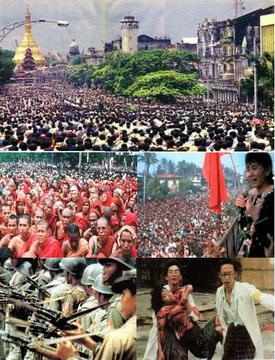
Forty-two years after her father's speech, Aung San Suu Kyi addressed another mass meeting of 500,000 people at the stupa, demanding democracy from the military regime and calling the 8888 Uprising the second struggle for independence.
Image source: 8888 Uprising
Sep 2007
% complete
During nationwide demonstrations against the military regime and its recently enacted price increases, protesting monks were denied access to the pagoda for several days before the government finally relented and permitted them in.
Sep 24, 2007
% complete
On September 24, 2007, 20,000 bhikkhus and thilashins — the largest protest in 20 years — marched at the Shwedagon Pagoda in Yangon.
Sep 25, 2007
% complete
On September 25, 2007, 2,000 monks and supporters defied threats from Myanmar's junta, continuing their protests despite warnings of a crackdown.
Sep 26, 2007
% complete
Clashes between security forces and thousands of protesters led by Buddhist monks left at least five protesters dead by Myanmar security forces, according to opposition reports, in an anticipated crackdown.
Image source: Saffron Revolution
Oct 1970
% complete
A moderate earthquake in October 1970 left the shaft of the hti out of alignment; extensive repairs were needed to rectify the problem.
2009
% complete
Completed in 2009, a pagoda similar in many aspects to Shwedagon Pagoda was built abroad, though its height is 30 cm (12 in) less than that of Shwedagon.
2010
% complete
Completed in 2010, another pagoda modeled on Shwedagon had its construction materials imported from Myanmar, reflecting the original's global influence.
Dec 2017
% complete
In December 2017, foreigners were charged a Ks.10,000 entrance fee to visit the Shwedagon Pagoda, formalizing tourist admission charges to the sacred site.
2019
% complete
In 2019, a monastery was inaugurated in Chisago City, Minnesota, United States modeled after the Shwedagon Pagoda, extending the shrine's legacy to North America.
Or browse the full history timeline directory, with more than 2,000 topics.
This Shwedagon Pagoda timeline was generated with the help of AI, using information found on the internet.
We work hard to keep these timelines accurate, but mistakes do get through. If you spot one, email us at [email protected] and we'll fix it for future visitors.
Generate yours with AI or build it from scratch, for free.
Export your timeline, add your own events, edit or remove AI-generated events, and much more
No credit card required.
Cancel anytime.
Cancel anytime.
You can create an unlimited number of timelines with up to 10 events on each one, customize how they look, export them to PDF, PNG, PowerPoint, CSV, and Excel, and share them with a link. Paid plans raise the event limit and add features like spreadsheet imports and collaborators.
Yes. You can cancel your subscription from your account page at any time, and you will not be charged again. Your subscription stays active for the rest of the period you already paid for.
Yes. We will email you a reminder before the annual renewal, and we will also email you a receipt.
Yes. You can email us within 15 days of any payment, and we will issue you a full refund.
Check out our pricing docs or send us an email anytime: [email protected].