
-
Use Cases
-
Resources
-
Pricing
Transcendentalism was an American philosophical, literary, and social movement that emerged in New England in the early 19th century. Centered in Concord and Boston, it emphasized individual intuition, self-reliance, nature, and a spiritual connection beyond empirical experience. Key figures included Ralph Waldo Emerson, Henry David Thoreau, Margaret Fuller, and Bronson Alcott. The movement influenced American literature, abolitionism, women's rights, and environmental thought. More Less
1800
% complete
Transcendentalism is closely related to Unitarianism, the liberal religious denomination that was dominant in Boston in the early nineteenth century. The movement grew out of Unitarian thought while pushing beyond its rationalism toward a more intuitive and spiritual understanding of the world.
1805
% complete
The election of Henry Ware as the Hollis Professor of Divinity at Harvard University in 1805 marked a decisive victory for Unitarianism at the institution, setting the intellectual stage from which Transcendentalism would later develop.
1810
% complete
John Thornton Kirkland's election as President of Harvard University in 1810 further consolidated Unitarian influence at Harvard. With Unitarianism firmly established there, the conditions were in place for Transcendentalism to begin developing among New England intellectuals.
Image source: Transcendentalism
Sep 12, 1836
% complete
Transcendentalism became a coherent movement and a sacred organization with the founding of the Transcendental Club in Cambridge, Massachusetts, on September 12, 1836, by prominent New England intellectuals including George Putnam, Ralph Waldo Emerson, and Frederic Henry Hedge.
Image source: Transcendental Club
1828
% complete
Ram Mohan Roy (1772–1833), founder of the Brahmo Samaj, rejected both Hindu mythology and the Christian trinity. In 1828 he asked for support for missionary activities from the American Unitarians, forging an early transatlantic religious connection.
1829
% complete
By 1829, Ram Mohan Roy had abandoned the Unitarian Committee in Calcutta. However, after Roy's death, the Brahmo Samaj maintained close ties with the Unitarian Church, which strove toward a rational faith, social reform, and their joining in a renewed religion.
Image source: Raja Ram Mohan Roy
1844
% complete
In 1844, the first English translation of the Lotus Sutra was included in The Dial, a publication of the New England Transcendentalists, translated from French by Elizabeth Palmer Peabody, reflecting the movement's interest in Eastern religious texts.
Image source: The Dial
1836
% complete
Influenced by Emerson and the importance of nature, Charles Stearns Wheeler built a shanty at Flint's Pond in 1836. It is considered the first Transcendentalist outdoor living experiment, and Wheeler used it during his summer vacations from Harvard from 1836 to 1842.
1837
% complete
Henry David Thoreau stayed at Wheeler's shanty for six weeks during the summer of 1837, where he got the idea that he wanted to build his own cabin — an idea later realized at Walden Pond in 1845.
1845
% complete
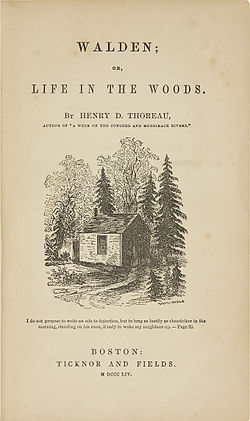
Thoreau realized the idea first sparked during his stay at Wheeler's shanty by building his own cabin at Walden Pond in 1845, beginning the famous experiment in simple living that would produce his masterpiece Walden.
Image source: Walden
1838
% complete
Edgar Allan Poe satirized transcendentalism in his 1838 story 'How to Write a Blackwood Article,' one of several works in which he mocked the movement and its followers, whom he elsewhere called 'Frogpondians' after the pond on Boston Common.
Image source: A Predicament
1841
% complete
Edgar Allan Poe continued his satire of transcendentalism in 'Never Bet the Devil Your Head' (1841), deriding the movement's followers as 'Frogpondians' after the pond on Boston Common, reflecting his broader disdain for New England literary culture.
Image source: Never Bet the Devil Your Head
1846
% complete
In his essay 'The Philosophy of Composition' (1846), Edgar Allan Poe denounced 'the excess of the suggested meaning,' continuing his pointed criticism of the Transcendentalist style of writing and its tendency toward overwrought symbolism.
Image source: The Philosophy of Composition
1852
% complete
Nathaniel Hawthorne satirized the movement in his novel The Blithedale Romance (1852), based on his experiences at Brook Farm, a short-lived utopian community founded on transcendental principles.
Image source: The Blithedale Romance
1840
% complete
From 1840, the Transcendentalists frequently published in their journal The Dial, along with other venues. The journal became the principal organ for expressing the movement's ideas on literature, philosophy, religion, and social reform.
1843
% complete
As early as 1843, in Summer on the Lakes, Margaret Fuller noted that 'the noble trees are gone already from this island to feed this caldron,' offering an early Transcendentalist critique of environmental destruction accompanying American expansion.
Image source: Summer on the Lakes
1850
% complete
The death of Margaret Fuller in 1850 deepened Emerson's conviction that Transcendentalism was dying out. He wrote, 'All that can be said is that she represents an interesting hour and group in American cultivation.'
Image source: Margaret Fuller
1854
% complete
In Walden (1854), Thoreau regarded the trains being built across America's landscape as a 'winged horse or fiery dragon' that 'sprinkle[d] all the restless men and floating merchandise in the country for seed,' critiquing industrialization's impact on nature.
1848
% complete
By the late 1840s, Ralph Waldo Emerson believed that the movement was dying out, and even more so after the death of Margaret Fuller in 1850, marking the waning of the movement's first wave.
1850 - 1870
% complete
Transcendentalism influenced the growing movement of 'Mental Sciences' of the mid-19th century, which would later become known as the New Thought movement, extending the movement's spiritual ideas into new forms of American metaphysical religion.
Image source: New Thought
1860 - 1899
% complete
Despite the decline of the first wave, a second wave of transcendentalists emerged later in the 19th century, including Moncure Conway, Octavius Brooks Frothingham, Samuel Longfellow, and Franklin Benjamin Sanborn, who carried the movement's ideals forward.
Or browse the full history timeline directory, with more than 2,000 topics.
This Transcendentalism timeline was generated with the help of AI, using information found on the internet.
We work hard to keep these timelines accurate, but mistakes do get through. If you spot one, email us at [email protected] and we'll fix it for future visitors.
Generate yours with AI or build it from scratch, for free.
Export your timeline, add your own events, edit or remove AI-generated events, and much more
No credit card required.
Cancel anytime.
Cancel anytime.
You can create an unlimited number of timelines with up to 10 events on each one, customize how they look, export them to PDF, PNG, PowerPoint, CSV, and Excel, and share them with a link. Paid plans raise the event limit and add features like spreadsheet imports and collaborators.
Yes. You can cancel your subscription from your account page at any time, and you will not be charged again. Your subscription stays active for the rest of the period you already paid for.
Yes. We will email you a reminder before the annual renewal, and we will also email you a receipt.
Yes. You can email us within 15 days of any payment, and we will issue you a full refund.
Check out our pricing docs or send us an email anytime: [email protected].