-
Use Cases
-
Resources
-
Pricing
Yugoslavia was a socialist state in Southeastern Europe that existed in various forms from 1918 to 2003. Formed after World War I from South Slavic peoples, it was reorganized under Josip Broz Tito after World War II as a communist federation of six republics. Following Tito's death in 1980, rising nationalism led to its dissolution through wars in the 1990s, resulting in the independent states of Serbia, Croatia, Bosnia and Herzegovina, Slovenia, Macedonia, and Montenegro. More Less
Jul 20, 1917
% complete
Moves towards the formal creation of Yugoslavia accelerated after the 1917 Corfu Declaration between the Yugoslav Committee and the government of the Kingdom of Serbia.
Image source: Corfu Declaration
Nov 3, 1918
% complete
Austria-Hungary collapsed after World War I in 1918, removing Habsburg rule over South Slavic lands and clearing the way for a union of the South Slavic peoples.
Image source: Austria-Hungary
Dec 1, 1918
% complete
The country was formed in 1918 immediately after World War I as the Kingdom of Serbs, Croats and Slovenes, through the merger of the Kingdom of Serbia with the provisional State of Slovenes, Croats and Serbs. It constituted the first union of South Slavic peoples as a sovereign state following centuries of foreign rule under the Ottoman Empire and the Habsburg monarchy.
Image source: Kingdom of Yugoslavia
Jun 4, 1920
% complete
The subsequent Treaty of Trianon in 1920 formally ceded the northern territories from Hungary to Yugoslavia.
Image source: Treaty of Trianon
Jan 31, 1921
% complete
A census taken in 1921 found that 99% of the population appeared to be deeply involved with their religion and practices.
Image source: Yugoslavia
Aug 16, 1921
% complete
Upon his father's death in 1921, Alexander I went on to rule the country through an extended period of political crisis that culminated in the 6 January Dictatorship.
Image source: Alexander I of Yugoslavia
Jul 13, 1922
% complete
Under the rule of the House of Karađorđević, the kingdom gained international recognition on 13 July 1922 at the Conference of Ambassadors in Paris.
Image source: Conference of Ambassadors
Jun 20, 1928
% complete
On 20 June 1928, Serb deputy Puniša Račić shot at five members of the opposition Croatian Peasant Party in the National Assembly, resulting in the death of two deputies on the spot and that of leader Stjepan Radić a few weeks later.
Image source: Yugoslavia
Jan 6, 1929
% complete
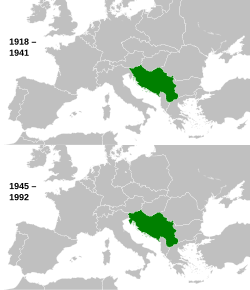
On 6 January 1929, King Alexander I got rid of the constitution, banned national political parties, assumed executive power, and renamed the country the Kingdom of Yugoslavia.
Image source: 6 January Dictatorship
Sep 3, 1931
% complete
King Alexander I imposed a new constitution and relinquished his dictatorship in 1931.
Oct 9, 1934
% complete
The king was assassinated in Marseille during an official visit to France in 1934 by Vlado Chernozemski, an experienced marksman from Ivan Mihailov's Internal Macedonian Revolutionary Organization with the cooperation of the Ustaše.
Oct 9, 1934 - Mar 27, 1941
% complete
Prince Paul headed the state as a prince regent until Alexander's son Peter II was declared of-age, which happened following the Yugoslav coup d'état in March 1941.
Image source: Prince Paul of Yugoslavia
Aug 26, 1939
% complete
Supported and pressured by Fascist Italy and Nazi Germany, Croatian leader Vladko Maček and his party managed the creation of the Banovina of Croatia, an autonomous region with significant internal self-government, in 1939.
Image source: Banovina of Croatia
Jan 1, 1941 - Dec 31, 1945
% complete
From 1941 to 1945, the Croatian Ustaše regime persecuted and murdered around 300,000 Serbs, along with at least 30,000 Jews and Roma; hundreds of thousands of Serbs were also expelled and another 200,000-300,000 were forced to convert to Catholicism.
Image source: Genocide of Serbs in the Independent State of Croatia
Mar 25, 1941
% complete
Prince Paul submitted to fascist pressure and signed the Tripartite Pact in Vienna on 25 March 1941, hoping to continue keeping Yugoslavia out of the war.
Mar 27, 1941
% complete
The Yugoslav coup d'état in March 1941 brought Peter II to power as king, declared of-age, ending the regency of Prince Paul shortly before the Axis invasion.
Image source: Yugoslav coup d'état
Apr 6, 1941
% complete
Hitler decided to attack Yugoslavia on 6 April 1941, when German, Italian and Hungarian forces invaded the kingdom, marking the start of World War II in Yugoslavia. The invasion was followed immediately by an attack on Greece where Mussolini had previously been repelled.
Image source: Invasion of Yugoslavia
Apr 10, 1941
% complete
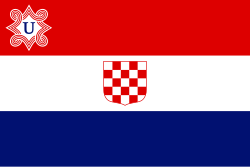
The Independent State of Croatia was established as a Nazi satellite state, ruled by the fascist Ustaše militia that had come into existence in 1929 but was relatively limited in its activities until 1941.
Image source: Independent State of Croatia
Nov 25, 1942
% complete
On 25 November 1942, the Anti-Fascist Council of National Liberation of Yugoslavia was convened in Bihać, modern day Bosnia and Herzegovina.
Image source: Anti-Fascist Council for the National Liberation of Yugoslavia
Nov 28, 1943 - Dec 1, 1943
% complete
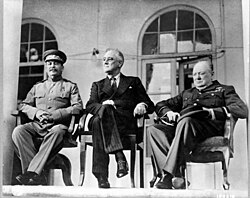
The Communist-led Partisan resistance proclaimed the Democratic Federal Yugoslavia and acquired the backing of the Allies at the Tehran Conference in late November 1943. From the start, the resistance consisted of two factions: the communist-led Partisans and the royalist Chetniks, with the former receiving Allied recognition.
Image source: Tehran Conference
Nov 29, 1943
% complete
The council reconvened on 29 November 1943, in Jajce, Bosnia and Herzegovina, and established the basis for post-war organisation of the country, establishing a federation (this date was celebrated as Republic Day after the war).
Jan 1, 1944 - Dec 31, 1944
% complete
The Yugoslav Partisans were able to expel the Axis powers from Serbia in 1944 and from the rest of Yugoslavia in 1945.
Image source: Belgrade offensive
Jun 16, 1944
% complete
Western attempts to reunite the Partisans with the émigrés loyal to the king led to the Tito-Šubašić Agreement in June 1944; however, Marshal Josip Broz Tito was in control and was determined to lead an independent communist state, starting as prime minister.
Image source: Tito–Šubašić Agreements
Sep 12, 1944
% complete
In 1944, King Peter II, then living in exile, gave his recognition to the Anti-Fascist Council for the National Liberation of Yugoslavia as the legitimate government.
Image source: Peter II of Yugoslavia
May 1, 1945 - May 31, 1945
% complete
In May 1945, the Partisans met with Allied forces outside former Yugoslav borders, after also taking over Trieste and parts of the southern Austrian provinces of Styria and Carinthia.
Image source: Josip Broz Tito
Mar 2, 1945 - Nov 11, 1945
% complete
The elections were called by the regency council appointed by the King on 2 March 1945. On 11 November 1945, parliamentary elections were held with only the Communist-led People's Front appearing on the ballot, securing all 354 seats in the newly formed Constituent Assembly.
Image source: 1945 Yugoslavian parliamentary election
Nov 29, 1945
% complete
The Constituent Assembly proclaimed Yugoslavia a federal republic on 29 November 1945, thus abolishing monarchical rule.
Image source: Socialist Federal Republic of Yugoslavia
Jan 31, 1946
% complete
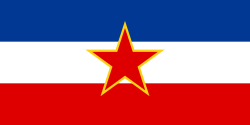
The 1946 Constitution of the Federal People's Republic of Yugoslavia, modelled after the Constitution of the Soviet Union, established six republics, an autonomous province, and an autonomous district that were a part of Serbia.
Image source: 1974 Yugoslav Constitution
Aug 1, 1947
% complete
In 1947, negotiations between Yugoslavia and Bulgaria led to the Bled agreement, which proposed to form a close relationship between the two Communist countries and enabled Yugoslavia to involve itself in the civil war in Greece, using Albania and Bulgaria as bases.
Jun 28, 1948
% complete
After all Communist European countries had deferred to Stalin and rejected the Marshall Plan aid in 1947, Tito broke decisively with Stalin in 1948 on other issues, making Yugoslavia an independent communist state distanced from the Soviets.
Image source: Tito–Stalin split
Jan 1, 1949 - Dec 31, 1953
% complete
American leaders were internally divided, but finally agreed and began sending money to Yugoslavia on a small scale in 1949, and on a much larger scale during 1950–53.
Sep 1, 1961
% complete
Tito criticised both Eastern Bloc and NATO nations and, together with India and other countries, started the Non-Aligned Movement in 1961, which remained the official affiliation of the country until it dissolved.
Image source: Non-Aligned Movement
Apr 7, 1963
% complete
On 7 April 1963, the nation changed its official name to the Socialist Federal Republic of Yugoslavia (SFRY), and Josip Broz Tito was named President for life.
Jan 1, 1967
% complete
Although Yugoslavia became a de facto atheist state, the Catholic Church maintained an active role in society; the Holy See normalized its relations with Yugoslavia by 1967 and worked together on stopping the Vietnam War. A 1964 survey showed just over 70% of the population still considered themselves religious believers.
Jun 2, 1968
% complete
First cracks in the tightly governed system surfaced when students in Belgrade and several other cities joined the worldwide protests of 1968.
Image source: 1968 student demonstrations in Yugoslavia
Jan 1, 1970 - Dec 31, 1971
% complete
A more severe sign of disobedience was the so-called Croatian Spring of 1970 and 1971, when students in Zagreb organised demonstrations for greater civil liberties and greater Croatian autonomy, followed by mass protests across Croatia.
Image source: Croatian Spring
Jun 20, 1972
% complete
On 20 June 1972, the Bugojno group attempted to infiltrate SFR Yugoslavia with the aim of inciting a rebellion against the socialist Yugoslav government. In 1985, they were arrested and imprisoned for attempted terrorism.
Feb 21, 1974
% complete
As a result of unrest, a new Constitution was ratified in 1974, which gave more rights to the individual republics in Yugoslavia and provinces in Serbia. Serbia's influence was significantly reduced while its autonomous provinces of Vojvodina and Kosovo were granted greater autonomy. This created tensions among Serb officials who viewed it as jeopardizing the unity of the country.
Image source: 1974 Yugoslav Constitution
May 4, 1980
% complete
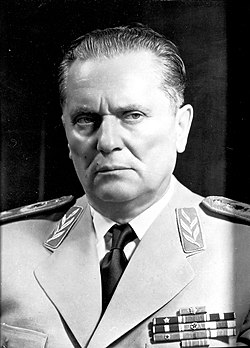
Partisan leader Josip Broz Tito ruled the country from 1944 until his death on 4 May 1980, first as prime minister and later as president. After his death, ethnic tensions grew, and a collective Presidency governed the country.
Image source: Death and state funeral of Josip Broz Tito
Mar 11, 1981
% complete
The Albanian majority in Kosovo demanded the status of a republic in the 1981 protests in Kosovo while Serbian authorities suppressed this sentiment and proceeded to reduce the province's autonomy.
Sep 1, 1986
% complete
In 1986, the Serbian Academy of Sciences and Arts drafted a memorandum addressing some burning issues concerning the position of Serbs as the most numerous people in Yugoslavia, fueling Serbian nationalism.
Jan 1, 1989 - Dec 31, 1990
% complete
In 1989, 248 firms were declared bankrupt or liquidated and 89,400 workers laid off. During the first nine months of 1990, another 889 enterprises with 525,000 workers suffered the same fate. An additional 20% of the work force, or half a million people, were not paid wages during early 1990 as enterprises sought to avoid bankruptcy.
Image source: Breakup of Yugoslavia
Feb 20, 1989
% complete
As Slobodan Milošević sought to restore pre-1974 Serbian sovereignty, ethnic Albanian miners in Kosovo organised the 1989 Kosovo miners' strike, which dovetailed into an ethnic conflict between Albanians and non-Albanians in the province. With Milošević gaining control over Kosovo in 1989, the region's demographics changed drastically.
Dec 31, 1989
% complete
After an economic and political crisis and the rise of nationalism and ethnic conflicts following Tito's death, Yugoslavia broke up along its republics' borders during the Revolutions of 1989, at first into five countries, leading to the Yugoslav Wars.
Image source: Revolutions of 1989
Jan 1, 1990 - Dec 31, 1990
% complete
Following the fall of communism in Eastern Europe, each of the republics held multi-party elections in 1990. Slovenia and Croatia subsequently proposed transforming Yugoslavia into a loose confederation of six republics.
Jan 20, 1990
% complete
In January 1990, the extraordinary 14th Congress of the League of Communists of Yugoslavia was convened, where the Serbian and Slovenian delegations argued over the future of the League of Communists and Yugoslavia, leading to its effective dissolution.
Image source: League of Communists of Yugoslavia
Aug 17, 1990
% complete
Serbian uprisings in Croatia began in August 1990 by blocking roads leading from the Dalmatian coast towards the interior, almost a year before Croatian leadership made any move towards independence. When Croatia attempted to replace police in the Serb-populated Krajina by force, the population sought refuge in Yugoslav Army barracks while the army remained passive. The federal army also tried to disarm Slovenia's territorial defence forces in 1990 but was not completely successful.
Image source: Log Revolution
Mar 9, 1991
% complete
On 9 March 1991, demonstrations were held against Slobodan Milošević in Belgrade, but the police and the military were deployed in the streets to restore order, killing two people.
Image source: 1991 protests in Belgrade
Mar 31, 1991
% complete
In late March 1991, the Plitvice Lakes incident was one of the first sparks of open war in Croatia between Croatian forces and Serb insurgents.
Image source: Plitvice Lakes incident
Jun 25, 1991
% complete
On 25 June 1991, Slovenia and Croatia became the first republics to declare independence from Yugoslavia. During the following three months, the Yugoslav Army completed its pull-out from Slovenia after the Ten-Day War, but in Croatia a bloody war broke out in the autumn of 1991.
Image source: Ten-Day War
Sep 8, 1991
% complete
In September 1991, the Republic of Macedonia also declared independence, becoming the only former republic to gain sovereignty without resistance from the Belgrade-based Yugoslav authorities.
Nov 9, 1991 - Nov 10, 1991
% complete
In the fall of 1991, the Bosnian Muslim Party of Democratic Action and the Croatian Democratic Union drafted a resolution for independence, causing a walkout among Bosnian Serb representatives. A Bosnian Serb referendum held on 9 and 10 November 1991 passed in favor of staying within a common state, and on 21 November the Assembly proclaimed such municipalities would be territory of the federal Yugoslav state.
Image source: Bosnia and Herzegovina
Nov 27, 1991
% complete
As a result of the conflict, the United Nations Security Council unanimously adopted UN Security Council Resolution 721 on 27 November 1991, which paved the way to the establishment of peacekeeping operations in Yugoslavia.
Image source: United Nations Security Council Resolution 721
Jan 9, 1992
% complete
On 9 January 1992, the Bosnian Serbs proclaimed the 'Republic of the Serbian People in Bosnia-Herzegovina', later known as Republika Srpska.
Image source: Republika Srpska
Feb 29, 1992 - Mar 1, 1992
% complete
From 29 February to 1 March 1992, a European Community-backed Bosnian referendum was held in which 99.7 percent voted for independence.
Image source: 1992 Bosnian independence referendum
Apr 6, 1992
% complete
On 6 April 1992, full recognition of Bosnia and Herzegovina's independence by the European Union followed by the United States, escalating the Bosnian War.
Apr 27, 1992
% complete
As the Yugoslav Wars raged through Bosnia and Croatia, the republics of Serbia and Montenegro, which remained relatively untouched by the war, formed a rump state known as the Federal Republic of Yugoslavia (FRY) in 1992. From 1992 to 2000, some countries, including the United States, referred to the FRY as Serbia and Montenegro as they viewed its claim to Yugoslavia's successorship as illegitimate.
Image source: Serbia and Montenegro
Jan 1, 1993 - Dec 31, 2017
% complete
From 1993 to 2017, the International Criminal Tribunal for the former Yugoslavia tried political and military leaders from the former Yugoslavia for war crimes, genocide, and other crimes committed during the Yugoslav Wars.
Image source: International Criminal Tribunal for the former Yugoslavia
Oct 5, 2000
% complete
In 2000, Milošević was prosecuted for atrocities committed during his ten-year rule in Serbia and the Yugoslav Wars. After his overthrow from power as president of the federation in 2000, the FRY dropped its succession aspirations, accepted the Badinter Arbitration Committee's opinion about shared succession, and gained UN membership on 2 November 2000.
Image source: Overthrow of Slobodan Milošević
Apr 1, 2001
% complete
In April 2001, the five successor states extant at the time drafted an Agreement on Succession Issues of the Former Socialist Federal Republic of Yugoslavia.
Image source: Agreement on Succession Issues of the Former Socialist Federal Republic of Yugoslavia
Feb 4, 2003
% complete
Marking an important transition in its history, the Federal Republic of Yugoslavia was officially renamed the State Union of Serbia and Montenegro in 2003.
Jun 3, 2006
% complete
In June 2006, Montenegro became an independent nation after the results of a May 2006 referendum, therefore rendering Serbia and Montenegro no longer existent.
Image source: 2006 Montenegrin independence referendum
Feb 17, 2008
% complete
In February 2008, the Republic of Kosovo declared independence from Serbia, leading to an ongoing dispute over whether Kosovo is a legally recognised state.
Image source: 2008 Kosovo declaration of independence
Or browse the full history timeline directory, with more than 2,000 topics.
This Yugoslavia timeline was generated with the help of AI, using information found on the internet.
We work hard to keep these timelines accurate, but mistakes do get through. If you spot one, email us at [email protected] and we'll fix it for future visitors.
Generate yours with AI or build it from scratch, for free.
Export your timeline, add your own events, edit or remove AI-generated events, and much more
No credit card required.
Cancel anytime.
Cancel anytime.
You can create an unlimited number of timelines with up to 10 events on each one, customize how they look, export them to PDF, PNG, PowerPoint, CSV, and Excel, and share them with a link. Paid plans raise the event limit and add features like spreadsheet imports and collaborators.
Yes. You can cancel your subscription from your account page at any time, and you will not be charged again. Your subscription stays active for the rest of the period you already paid for.
Yes. We will email you a reminder before the annual renewal, and we will also email you a receipt.
Yes. You can email us within 15 days of any payment, and we will issue you a full refund.
Check out our pricing docs or send us an email anytime: [email protected].